I don't believe in revolutions. It's just that they have too much of that: they tend to make things revolve, go in cycles. Look at the French and American revolutions, past lunges at freedom and equality in countries whose governments today rule primarily for the benefit of rich corporations; look at the Cuban revolution, already stumbling and being worked against by the exiled outside and the disillusioned inside.
If you have a revolution, it's very likely that in 30, 50 or a 100 years you will have a counter-revolution (except that the counter-revolutionaries would call it a revolution, too). The part of society that you stomped on during your revolution will grow in the dark, under the grooves in your soles, and no matter how heavy your feet are, they'll eventually shoot up branches and destabilize you till you topple. Even if you killed the last one of "them", even if their views were indeed responsible for a lot of unhappiness in your society, the violence you used legitimizes any future violence against you.
This is not to say that I don't see the need for change. In the particular case of our modern global society, where the greed for profit takes advantage of such obsolete ideas as national identity and local pride to blindside people into supporting policies that devastate their neighbors and, ultimately, ruin their own future, change is imperative.
But there are alternatives to violence. There have to be. A change of regime is not enough. We need to change the mode of historical change.
Sunday, October 26, 2008


Friday, October 24, 2008
The Story of Stuff
Check this out:
En español: http://www.youtube.com/watch?v=THGlNspyXDc
Or in English: http://www.youtube.com/watch?v=gLBE5QAYXp8
En español: http://www.youtube.com/watch?v=THGlNspyXDc
Or in English: http://www.youtube.com/watch?v=gLBE5QAYXp8
Wednesday, October 22, 2008
On bloggin and facebooking
I feel almost furtive writing here again. Most of the bloggers in my contact list have abandoned the blogging arena, their latest entries dating back to sometime in 2007. They are happily facebooking around, now. There's even a blog application over there, and i've indeed tried it, but there's too much traffic, too many buttons and links... Not to deny the merits of facebook nor anything (i mean, it's almost replaced e-mail for me) but as far as blogging goes, facebook seems like the easy way out. Instead of making an effort to knead your thoughts together, you can simply get away with a one-liner answer to the "what are you doing right now?" question on top of the main page. It's quite distracting.
Here, instead, the cybernetic air is purer, one has more space to breathe. Been thinking of taking my blog up again for a while now, and yesterday i posted my first entry.
Here, instead, the cybernetic air is purer, one has more space to breathe. Been thinking of taking my blog up again for a while now, and yesterday i posted my first entry.
Tuesday, October 21, 2008
Almost a lynching
I watched the saddest video today.
One can basically see this thief, or rather, the crowd that surrounds him when they catch him red handed, apparently trying to pick the pockets of an elderly man in my hometown in Argentina. They're talking to the thief and among themselves as they wait for the police to arrive, everything caught on camera by someone who gets there running, obviously desperate to capture the action. It's a summer day, short sleeves and bermuda shorts all around.
The thief is kneeling in a corner (you see him later), but at first you can only hear his voice: "I haven't done anything. Nothing happened." There's fear in it, and his Spanish is quite different from that of his captors, all from a different class, quite united against him. One of them, a guy younger than me, probably another regular passer by on his way somewhere when detoured by the fracas, says: "Let's kill him. Let's hang him from a tree and burn him. It's your fault that in this country we are in the situation we are." Literally.
The old man wants at him, too, but a couple of guys nearest the thief luckily make sure nobody touches him til the police arrives. When two officers finally do, they're greeted by general applause, and some irony. "Los bicivoladores", someone mutters, as they dismount from their bikes. Finally we see the thief, a slight, dark haired man on his knees. One of the policemen pulls the guy's hands back and cuffs them; his face is shoved against the wall. The crowd begins to disperse, and the video ends here.
Friday, March 16, 2007
This was wednesday...
...from 7:00 am till 5:30 pm. 560 damajuanas.
 Uncle Oscar & sodium metabisulblahblah, cousin Caro
carrying damajuanas, cousin Alberto corking, and aunt
Nilda filling them up.


 Aunt Nilda & her labels.
 LA ÍRIDE, Malbec Roble (proud we are, yes)
And, tomorrow... harvest & new wine making!
 Uncle Oscar & sodium metabisulblahblah, cousin Caro
carrying damajuanas, cousin Alberto corking, and aunt
Nilda filling them up.


 Aunt Nilda & her labels.
 LA ÍRIDE, Malbec Roble (proud we are, yes)
And, tomorrow... harvest & new wine making!
Tuesday, March 13, 2007
Bottle washing and family reunion
 An intense weekend. First, on saturday, my dad and i got up at 7:00, filled a thermos with hot water for mate, bought some hot "tortitas" and drove to the winery. We joined my uncle Oscar and cousin Osvaldo there, who were already washing bottles. The bottles in question are special ones; their equivalent in Norway would be the 3 liter wine boxes, except that these bottles have capacity for 5 liters instead. They look just like this one on the left, little plastic basket and all. In my translation i've called them "bottles", but they look more like jugs, don't they? Anyways, the spanish word for them is "damajuanas", which would literally translate as "ladyjanes". This isn't an english word at all, but it's more fun to say i spent saturday washing lady Janes (lady Jane's what?) than to say i spent it washing bottles.
Thing is, each time you sell a lady Jane filled with wine, you get back an empty one from the customer. That way, wineries don't need to be buying new lady Janes all the time. You simply remove the old labels, wash it inside and out, fill it with wine, stick a new label, and voilá! Lady Jane is again ready to pour.
Sounds simple, but it has its method. First you fill many vats with warm water and soak the lady Janes in them, bottoms up, so that the labels soften up and become easier to remove. You move from one vat to the next, with a scouring pad for the recalcitrant bit of paper and a penknife to get rid of the plastic capsules. You also need a special tool to remove the occasional piece of cork from lady Jane's insides.
After that, each lady Jane gets its insides washed by a special machine (operated by hand) that shoots high pressure jets of a solution of water and caustic soda. Then they go through another vat in which they are rinsed inside and out and their baskets are checked and replaced, if necessary. Finally, they go through the special machine once more, except this time they get only water, in order to make sure that all the caustic soda is completely removed. Finally you pile them up, and they are (almost) ready to be filled.
On saturday we managed to prepare thus 600 lady Janes, which we'll fill this wednesday. We'll use the special washing machine once more, this time with a solution of water and sodium metabisulphite (a sanitizer). By means of a pump, this solution will also be made to run through the pipes that will be used to transfer the wine from the tanks to the dossifier, also operated by hand. We'll cork them with another machine, put plastic capsules on top, seal them with heat, hand glue the labels, and stack them. It'll be another long day, but it's fun: everybody jokes and chats, we pause around noon, drink mate, eat some sandwiches...
Sunday was lighter, but very "familiar", too. Got together for lunch with a few uncles and cousins... Here's some pics:


Wednesday, March 07, 2007
Vendimia
Vendimia is the spanish word for grape harvest. It signifies the action, but it is also applied to the time of year in which grapes are picked. In Mendoza, that time is now, and for the few weeks that vendimia lasts, it dominates everything. Each district has its own vendimia celebration through january and february, and then finally in early march there are parades with floats in the capital city. There's a traditional pageant in which a "vendimia queen" is chosen, a gay pageant that mimics it, fireworks, an artsy show in an amphitheater, wine parties everywhere...
Paralell to all this, local news talk about disagreements between grape growers and wine makers about what the fair price of grapes should be. The weather can play foul, too: sometimes you're about to begin harvesting, and your grapes are hit by hail, which may knock off as much as 90% of your production...
Right after the 2001 crisis my dad and his brothers pooled together the savings left from the disappearance act managed by the Argentinean banking system at that time and started a tiny winery. Years before they'd bought a couple of hectares of near desert land in Maipú; now they put it to use by building a shed to house the fermentation tanks and other equipment made by one of my uncles at the metalurgical workshop he works at. On the rest of the land they planted some vines (Malbec, Cabernet Sauvignon and even a little Chardonnay) that are cared for, on a rotational basis, by each of the associates. A cousin made a website to publicize the business and voilá... they had a vacuum cleaner that's been sucking in money since then. Since the production capacity of the place is so small, their strategy has been to make real good wines, but still, our enologist says that time is needed, that creating a market for a wine is a slow process... This year it seems they might in fact break even...
Anyway, the nice thing about this little winery is that the whole family gets together during vendimia. We pick our own grapes and, assessed by an enologist, we even make our own wines. Of course, i say "we", yet living abroad, this will be the first year i'm part of all this. I'm really excited about it, and i'll keep you updated.
Paralell to all this, local news talk about disagreements between grape growers and wine makers about what the fair price of grapes should be. The weather can play foul, too: sometimes you're about to begin harvesting, and your grapes are hit by hail, which may knock off as much as 90% of your production...
Right after the 2001 crisis my dad and his brothers pooled together the savings left from the disappearance act managed by the Argentinean banking system at that time and started a tiny winery. Years before they'd bought a couple of hectares of near desert land in Maipú; now they put it to use by building a shed to house the fermentation tanks and other equipment made by one of my uncles at the metalurgical workshop he works at. On the rest of the land they planted some vines (Malbec, Cabernet Sauvignon and even a little Chardonnay) that are cared for, on a rotational basis, by each of the associates. A cousin made a website to publicize the business and voilá... they had a vacuum cleaner that's been sucking in money since then. Since the production capacity of the place is so small, their strategy has been to make real good wines, but still, our enologist says that time is needed, that creating a market for a wine is a slow process... This year it seems they might in fact break even...
Anyway, the nice thing about this little winery is that the whole family gets together during vendimia. We pick our own grapes and, assessed by an enologist, we even make our own wines. Of course, i say "we", yet living abroad, this will be the first year i'm part of all this. I'm really excited about it, and i'll keep you updated.
Thursday, March 01, 2007
At last!
Been in Argentina for a bit over a month now, and it's taken me this long to get a connection at home, even though i ordered it the day after i arrived. Petulant as i may sound, things do move at a totally different pace in here. I'd forgotten about that, and for that reason among others, i've been feeling a bit out of place. This feeling, rather than internetlessness, has been the real cause of my blogging silence... That and a summer flu, a trip to the countryside... and a sense of being speechless in the face of tragedy.
Anyway, i'll start light, with some pictures from my trip to Malargüe, in southern Mendoza. First, though, a little tableau i witnessed today in the city center:
A toy store on a corner, a man dressed as Barney the dinosaur in front of it. He's chatting with a pretty, young woman who holds a baby in her arms. Barney's mouth is open, and through a slit at the back of it the man inside looks out into the world. What he doesn't see is the 7-or-8 year old boy who comes running from behind him, grabs the tail of his screen hero, and begins to pull it around heedless of his mother's calls. Barney is in shock. He tries to look back, but his thick plushy body has no neck to speak of. Finally the man thinks of pulling Barney's head off of his own, glares at the boy and says: "Qué te pasa, culeau?" (literally: "What is it, you ass-fucked one?"). Maybe it was too hot inside that suit.
So, here's the pics:
 These formations are near the Atuel canyon, in San Rafael. We decided not to carve any presidents' faces here, for obvious reasons.
 Agua del Toro Dam, with mom & dad.
 Valle Hermoso, Malargüe.
 Laguna de Llancanelo.
 Flamingos at Llancanelo.
Sigh! I did miss all of this, after all...
Anyway, i'll start light, with some pictures from my trip to Malargüe, in southern Mendoza. First, though, a little tableau i witnessed today in the city center:
A toy store on a corner, a man dressed as Barney the dinosaur in front of it. He's chatting with a pretty, young woman who holds a baby in her arms. Barney's mouth is open, and through a slit at the back of it the man inside looks out into the world. What he doesn't see is the 7-or-8 year old boy who comes running from behind him, grabs the tail of his screen hero, and begins to pull it around heedless of his mother's calls. Barney is in shock. He tries to look back, but his thick plushy body has no neck to speak of. Finally the man thinks of pulling Barney's head off of his own, glares at the boy and says: "Qué te pasa, culeau?" (literally: "What is it, you ass-fucked one?"). Maybe it was too hot inside that suit.
So, here's the pics:
 These formations are near the Atuel canyon, in San Rafael. We decided not to carve any presidents' faces here, for obvious reasons.
 Agua del Toro Dam, with mom & dad.
 Valle Hermoso, Malargüe.
 Laguna de Llancanelo.
 Flamingos at Llancanelo.
Sigh! I did miss all of this, after all...
Sunday, January 14, 2007
Fra Bergen...
First entry of the new year...
Speaking of which, have you ever wondered why the formula is "Merry Christmas and Happy New Year" but not "Happy Christmas and Merry New Year"? Not that finding an answer to this would be very relevant, but still, one wonders... Perhaps what people are really saying when they exchange this words is simply "Hey, I'm thinking of you at this time" (for whatever reason that may be).
Anyway, am in Bergen right now. These last 20 or so days have definitely included some variety. On my way to Valencia from Tromsø, stopped in London and met with Gerardo, a friend from my own years as a UWC student. Since i practically wheezed through the city, we didn't have time for more than one afternoon together, but we did have a couple of beers and a nice chat. Weird thing, the way it goes with old UWC friends when they meet again. We hadn't talked in quite a while and we have both obviously changed very much since our highschool days, yet it was easy to reconnect. Cheesy as it may sound, i still believe that what we shared in those two years was so fundamental that it will always form a kind of link with my mates from that time, no matter how long the intervening months or years stretch (roll your eyes all you want).
The Gerardo i remembered was very carefree and somewhat cynical... The one i met now said he was worried about the time he had "wasted", but a little less pessimistic, less guarded with his emotions (and he's living in England! go figure...). Physically, he hasn't changed much, and he still has the same quirky sense of humour i remember. It is good to know he's out there, you know? Do you ever get that feeling about distant friends? That you don't need to talk to them all the time -- not even so often, but that it makes you happy just to know that they are alive.
And then, Valencia. Spent almost two weeks with my brother Leandro and his wife, Celia. I love those two. They're really in love with each other.
Speaking of which, have you ever wondered why the formula is "Merry Christmas and Happy New Year" but not "Happy Christmas and Merry New Year"? Not that finding an answer to this would be very relevant, but still, one wonders... Perhaps what people are really saying when they exchange this words is simply "Hey, I'm thinking of you at this time" (for whatever reason that may be).
Anyway, am in Bergen right now. These last 20 or so days have definitely included some variety. On my way to Valencia from Tromsø, stopped in London and met with Gerardo, a friend from my own years as a UWC student. Since i practically wheezed through the city, we didn't have time for more than one afternoon together, but we did have a couple of beers and a nice chat. Weird thing, the way it goes with old UWC friends when they meet again. We hadn't talked in quite a while and we have both obviously changed very much since our highschool days, yet it was easy to reconnect. Cheesy as it may sound, i still believe that what we shared in those two years was so fundamental that it will always form a kind of link with my mates from that time, no matter how long the intervening months or years stretch (roll your eyes all you want).
The Gerardo i remembered was very carefree and somewhat cynical... The one i met now said he was worried about the time he had "wasted", but a little less pessimistic, less guarded with his emotions (and he's living in England! go figure...). Physically, he hasn't changed much, and he still has the same quirky sense of humour i remember. It is good to know he's out there, you know? Do you ever get that feeling about distant friends? That you don't need to talk to them all the time -- not even so often, but that it makes you happy just to know that they are alive.
And then, Valencia. Spent almost two weeks with my brother Leandro and his wife, Celia. I love those two. They're really in love with each other.
Wednesday, December 20, 2006
Brain
Brain seems to have gone into hybernation. Didn't think the lack of light would affect me in any way, but apparently it has. Not that am depressed nor anything, but my sleeping pattern's become... well, patternless. Was never very solid to begin with, you'll say; totally agree, but it's never happened that i go to bed at 11:00 am and wake up at 4:00 in the afternoon, then take a nap from midnight till 1:30. That was today. Put the hours of the day in a shaker glass and then spill them on the table, and you have my waking cycle over the last three or four weeks.
Brain's very silent, too. Probably snowing a lot in there as well. Got to shake it up a little.
Got to finish packing first, though. Then take a shower. Cab's coming to pick me up in a few hours and then it's ha det bra til Tromsø. Will be in London till the 23rd, and then on to Valencia.
Ooh! Brain just woke up. Thinking of the seventh commandment. Just looked it up on wiki, and it says "Do not commit adultery". When i went through catholic catechism as a child, though, it was "Do not covet the woman of your neighbor".
Catechism classes were mixed. Boys and girls from 6th and 7th grade had them after school, every wednesday. Two years, and then you were ready to take the first communion. Must have been strange for the girls. For them the seventh commandment was not an admonition against adultery, but against lesbianism with married women. Gay boys like me, on the other hand, were scot free: it sounded like that commandment in particular had no bearing on us. Not that coveting a married man is much fun, anyways.
At any rate, the message is clear: whatever your sex and sexual orientation, adultery is a no-no. That's to say, if you're married, do not sleep with married people other than your own spouse. Any other sex partner must be unmarried.
Isn't semantics an amazing thing?
Brain's very silent, too. Probably snowing a lot in there as well. Got to shake it up a little.
Got to finish packing first, though. Then take a shower. Cab's coming to pick me up in a few hours and then it's ha det bra til Tromsø. Will be in London till the 23rd, and then on to Valencia.
Ooh! Brain just woke up. Thinking of the seventh commandment. Just looked it up on wiki, and it says "Do not commit adultery". When i went through catholic catechism as a child, though, it was "Do not covet the woman of your neighbor".
Catechism classes were mixed. Boys and girls from 6th and 7th grade had them after school, every wednesday. Two years, and then you were ready to take the first communion. Must have been strange for the girls. For them the seventh commandment was not an admonition against adultery, but against lesbianism with married women. Gay boys like me, on the other hand, were scot free: it sounded like that commandment in particular had no bearing on us. Not that coveting a married man is much fun, anyways.
At any rate, the message is clear: whatever your sex and sexual orientation, adultery is a no-no. That's to say, if you're married, do not sleep with married people other than your own spouse. Any other sex partner must be unmarried.
Isn't semantics an amazing thing?
Friday, December 08, 2006
"Panic"
Just read the script of this amazing play by Mika Myllyaho. My first encounter with finnish literature (in translation, of course) and have definitely NOT been disappointed. A bit like "Women on the edge of a nervous breakdown", but with men instead of women. Would really love to seen this acted...
Wednesday, November 29, 2006
La complainte du progrès
Hehm... I'm just noticing my last posting was about complaining... Well, this one is about a lament. Haven't felt like blogging in the last few days, but was organizing my music this morning and came across this song by Boris Vian: perfect to fill in some space and deaden that sense of guilt...
Autrefois pour faire sa cour
On parlait d'amour;
Pour mieux prouver son ardeur
On offrait son coeur.
Maintenant c'est plus pareil.
Ça change, ça change...
Pour séduire le cher ange
On lui glisse à l'oreille:
Ah Gudule, viens m'embrasser, et je te donnerai...
Un frigidaire,
Un joli scooter,
Un atomixer
Et du Dunlopillo.
Une cuisinière
Avec un four en verre,
Des tas de couverts
Et des pelles à gâteau!
Une tourniquette
Pour faire la vinaigrette,
Un bel aérateur
Pour bouffer les odeurs,
Des draps qui chauffent,
Un pistolet à gaufres,
Un avion pour deux...
Et nous serons heureux!
Autrefois s'il arrivait
Que l'on se querelle,
L'air lugubre, on s'en allait,
En laissant la vaisselle.
Maintenant, que voulez-vous,
La vie est si chère...
On dit: "rentre chez ta mère"
Et on se garde tout.
Ah Gudule, excuse-toi, ou je reprends tout ça...
Mon frigidaire,
Mon armoire à cuillers,
Mon évier en fer,
Et mon poêle à mazout.
Mon cire-godasses,
mon repasse-limaces,
Mon tabouret-à-glace
Et mon chasse-filous!
La tourniquette
À faire la vinaigrette,
Le ratatineur dur
Et le coupe friture.
Et si la belle
Se montre encore rebelle
On la ficelle dehors,
Pour confier son sort
Au frigidaire,
À l'efface-poussière,
A la cuisinière,
Au lit qu'est toujours fait,
Au chauffe-savates,
Au canon à patates,
A l'éventre-tomates,
À l'écorche-poulet!
Mais très, très vite
On reçoit la visite
D'une tendre petite
Qui vous offre son coeur...
Alors on cède
Car il faut qu'on s'entraide
Et l'on vit comme ça
Jusqu'à la prochaine fois!
Autrefois pour faire sa cour
On parlait d'amour;
Pour mieux prouver son ardeur
On offrait son coeur.
Maintenant c'est plus pareil.
Ça change, ça change...
Pour séduire le cher ange
On lui glisse à l'oreille:
Ah Gudule, viens m'embrasser, et je te donnerai...
Un frigidaire,
Un joli scooter,
Un atomixer
Et du Dunlopillo.
Une cuisinière
Avec un four en verre,
Des tas de couverts
Et des pelles à gâteau!
Une tourniquette
Pour faire la vinaigrette,
Un bel aérateur
Pour bouffer les odeurs,
Des draps qui chauffent,
Un pistolet à gaufres,
Un avion pour deux...
Et nous serons heureux!
Autrefois s'il arrivait
Que l'on se querelle,
L'air lugubre, on s'en allait,
En laissant la vaisselle.
Maintenant, que voulez-vous,
La vie est si chère...
On dit: "rentre chez ta mère"
Et on se garde tout.
Ah Gudule, excuse-toi, ou je reprends tout ça...
Mon frigidaire,
Mon armoire à cuillers,
Mon évier en fer,
Et mon poêle à mazout.
Mon cire-godasses,
mon repasse-limaces,
Mon tabouret-à-glace
Et mon chasse-filous!
La tourniquette
À faire la vinaigrette,
Le ratatineur dur
Et le coupe friture.
Et si la belle
Se montre encore rebelle
On la ficelle dehors,
Pour confier son sort
Au frigidaire,
À l'efface-poussière,
A la cuisinière,
Au lit qu'est toujours fait,
Au chauffe-savates,
Au canon à patates,
A l'éventre-tomates,
À l'écorche-poulet!
Mais très, très vite
On reçoit la visite
D'une tendre petite
Qui vous offre son coeur...
Alors on cède
Car il faut qu'on s'entraide
Et l'on vit comme ça
Jusqu'à la prochaine fois!
On Children
One day when i was a kid of 8 or 9 my mom came back from the grocer's shop and recited this poem to me and my brothers. She had written it on the backside of her shopping list, having copied it off a poster on one of the shop's walls while she was waiting for her turn. You know, one of those tacky posters with a sunset on the background and some text written in curly letters. It happened to be a fragment of Khalil Gibran's "The Profet":
Your children are not your children.
They are the sons and daughters of Life's longing for itself.
They come through you but not from you,
And though they are with you, yet they belong not to you.
You may give them your love but not your thoughts,
For they have their own thoughts.
You may house their bodies but not their souls,
For their souls dwell in the house of tomorrow,
which you cannot visit, not even in your dreams.
You may strive to be like them, but seek not to make them like you.
For life goes not backward nor tarries with yesterday.
These lines stayed with me for a long time, but it was only a couple of years ago, when a student lent me Gibran's book, that i discovered where they came from. The makers of the poster at the grocer's shop of my childhood had not bothered to mention the author, as i saw myself when it was my turn to go shopping. Yet, their spanish translation was faithful enough that when i came across the fragment in english, over 20 years later, i recognized it.
Then again today, while surfing on the net, i found Sweet Honey on the Rock's musical version of the text, and it brought the memory up again.
My mom did not have the opportunity to go to school beyond the 6th grade. She had to work from a very young age, and her parents couldn't afford, or didn't think it important enough, to educate her beyond elementary school. All her life she's had to fight against the disadvantages this meant for her. Her lack of a formal education could have made her deny it to us, perhaps, or become so obsessed with it that she pushed us towards the "good and profitable" fields of study, ways of life, worldviews...
Yet she and my dad always made it clear that we could choose what we wanted, even when it was obvious they didn't understand our choices. When i told them i was going to study literature they must have been scared shitless: that really is a starvation sentence in a small town in Argentina. When i came out to them (rather, when they figured out i was gay), the notion must have gone against everything they were brought up to believe, yet they dealt and are dealing with it. Two of their three children have emigrated, and the third will probably do so next year. If we miss them, i can't imagine how they must miss us.
Of course, parents have their own ideas about life and what's right, and you live by those when you're little... When you start to get older, some of their values and points of view have stuck to you, and even if you see things differently, there's a time when you're still sensitive to their preferences... Some of those you spend years trying to shed off, only to discover they've crept back on you when you least expect it.
I think about my mom going into that grocer's shop and coming across that poem on the wall. It must have truly spoken to her beliefs, for her to come back so excited and read the poem to us so enthusiastically.
Your children are not your children.
They are the sons and daughters of Life's longing for itself.
They come through you but not from you,
And though they are with you, yet they belong not to you.
You may give them your love but not your thoughts,
For they have their own thoughts.
You may house their bodies but not their souls,
For their souls dwell in the house of tomorrow,
which you cannot visit, not even in your dreams.
You may strive to be like them, but seek not to make them like you.
For life goes not backward nor tarries with yesterday.
These lines stayed with me for a long time, but it was only a couple of years ago, when a student lent me Gibran's book, that i discovered where they came from. The makers of the poster at the grocer's shop of my childhood had not bothered to mention the author, as i saw myself when it was my turn to go shopping. Yet, their spanish translation was faithful enough that when i came across the fragment in english, over 20 years later, i recognized it.
Then again today, while surfing on the net, i found Sweet Honey on the Rock's musical version of the text, and it brought the memory up again.
My mom did not have the opportunity to go to school beyond the 6th grade. She had to work from a very young age, and her parents couldn't afford, or didn't think it important enough, to educate her beyond elementary school. All her life she's had to fight against the disadvantages this meant for her. Her lack of a formal education could have made her deny it to us, perhaps, or become so obsessed with it that she pushed us towards the "good and profitable" fields of study, ways of life, worldviews...
Yet she and my dad always made it clear that we could choose what we wanted, even when it was obvious they didn't understand our choices. When i told them i was going to study literature they must have been scared shitless: that really is a starvation sentence in a small town in Argentina. When i came out to them (rather, when they figured out i was gay), the notion must have gone against everything they were brought up to believe, yet they dealt and are dealing with it. Two of their three children have emigrated, and the third will probably do so next year. If we miss them, i can't imagine how they must miss us.
Of course, parents have their own ideas about life and what's right, and you live by those when you're little... When you start to get older, some of their values and points of view have stuck to you, and even if you see things differently, there's a time when you're still sensitive to their preferences... Some of those you spend years trying to shed off, only to discover they've crept back on you when you least expect it.
I think about my mom going into that grocer's shop and coming across that poem on the wall. It must have truly spoken to her beliefs, for her to come back so excited and read the poem to us so enthusiastically.
Wednesday, November 22, 2006
Complaint
I saw this poster on a bus, and took a picture.

It's basically an add from the consumers' council here in Norway. The card says:
"To Vinedal Catering:
RE our wedding,
we just wanted to say that
THE FOOD SUCKED!
................Camilla & Anders"
And then the caption underneath goes:
"DISSATISFIED?
The Consumers' Council will help you."
Heheheh. Made me smile.

It's basically an add from the consumers' council here in Norway. The card says:
"To Vinedal Catering:
RE our wedding,
we just wanted to say that
THE FOOD SUCKED!
................Camilla & Anders"
And then the caption underneath goes:
"DISSATISFIED?
The Consumers' Council will help you."
Heheheh. Made me smile.
Not fair!
US policies cost Latin America years under dictatorships, economic & social crises... and all Argentina manages to get back is Barbara Bush's purse and cell phone??? Which, rather than being shared, the pickpocket will surely keep -- that is how politics always works in Argentina, anyway.
Monday, November 20, 2006
Mary
Ok, back to one of my pet topics. Seriously, i don't do it on purpose, but just now i found myself thinking about religion... and the virgin Mary.
Why was it so important that Jesus' mother was a virgin? Would either of them have lost any sacredness if she hadn't been? I mean, that a virgin conceived god's son is not so spectacular, given that he is almighty and all... Wouldn't it be even more miraculous if Mary hadn't been a virgin, people had known it, and still they had accepted Jesus as the son of god?
Also, i'm wondering, why couldn't god have used Joseph's sperm to fertilize Mary? If he didn't, did he cause her egg to have a full set of 46 chromosomes, rather than the normal 23? Or was her egg just a regular one, and god just made 23 additional chromosomes to simply appear inside it? What were the genes in god's Y chromosome, for instance? I mean, i know Jesus is the spirit made flesh, but the instructions to make flesh are contained in DNA, which is matter... Did god concoct his own kind of DNA just on the spot, at the moment of Jesus' conception, or did he copy it from someone else, from people already living or who had lived in the past? If the first, it would really be interesting to see how god's DNA looks like; if the second, who did he pick as model/s?
In either case, what kind of genetic traits did he pick over what others? Knowing how fractious people are, isn't it a bit careless to make the redeemer of all humankind look like the members of one group in particular? It'd have simplified things if he'd included a disclaimer, something like "don't fight guys; it was a random process; i did it with my eyes closed -- he just happened to come out male and caucasian".
Why was it so important that Jesus' mother was a virgin? Would either of them have lost any sacredness if she hadn't been? I mean, that a virgin conceived god's son is not so spectacular, given that he is almighty and all... Wouldn't it be even more miraculous if Mary hadn't been a virgin, people had known it, and still they had accepted Jesus as the son of god?
Also, i'm wondering, why couldn't god have used Joseph's sperm to fertilize Mary? If he didn't, did he cause her egg to have a full set of 46 chromosomes, rather than the normal 23? Or was her egg just a regular one, and god just made 23 additional chromosomes to simply appear inside it? What were the genes in god's Y chromosome, for instance? I mean, i know Jesus is the spirit made flesh, but the instructions to make flesh are contained in DNA, which is matter... Did god concoct his own kind of DNA just on the spot, at the moment of Jesus' conception, or did he copy it from someone else, from people already living or who had lived in the past? If the first, it would really be interesting to see how god's DNA looks like; if the second, who did he pick as model/s?
In either case, what kind of genetic traits did he pick over what others? Knowing how fractious people are, isn't it a bit careless to make the redeemer of all humankind look like the members of one group in particular? It'd have simplified things if he'd included a disclaimer, something like "don't fight guys; it was a random process; i did it with my eyes closed -- he just happened to come out male and caucasian".
Sunday, November 19, 2006
Marcelo Tinelli & the Mapuche
Not the name of a rock group, i'm afraid.
Marcello Tinelli: a famous Argentinean TV presenter and comedian.
The Mapuche: the only indigenous group that, although seriously decimated and marginalized, managed to preserve its culture and language in Patagonia.
Marcello Tinelli: has bought thousands of acres in the Patagonic province of Chubut.
The Mapuche: 30 families live in this land, part of a community of around 700 individuals who, although there for centuries, still have no legal possession.
Marcello Tinelli: wants to build a mega tourist center (it would have a Mapuche name).
The Mapuche: have to go.
The argentinean government: does nothing, of course.
The argentinean media: not a peep.
Money: talks!
More info:
Universidad de Quilmes: http://extramuros.unq.edu.ar/03/art_moira_millan_3.htm
Marcello Tinelli: a famous Argentinean TV presenter and comedian.
The Mapuche: the only indigenous group that, although seriously decimated and marginalized, managed to preserve its culture and language in Patagonia.
Marcello Tinelli: has bought thousands of acres in the Patagonic province of Chubut.
The Mapuche: 30 families live in this land, part of a community of around 700 individuals who, although there for centuries, still have no legal possession.
Marcello Tinelli: wants to build a mega tourist center (it would have a Mapuche name).
The Mapuche: have to go.
The argentinean government: does nothing, of course.
The argentinean media: not a peep.
Money: talks!
More info:
Universidad de Quilmes: http://extramuros.unq.edu.ar/03/art_moira_millan_3.htm
Friday, November 17, 2006
Recruiting campaign
Just checked my yahoo & msn accounts, and there's these new US army adds everywhere. A new recruiting campaign:
"Climbing a mountain is strong.
Landing a helicopter on a mountain is Army Strong!
There's strong... And there's Army Strong!"
Just google "Army Strong" to read more about this, if you're interested. I just wonder... Do they mean strong as in "brute force"? Have they thought of trying with other adjectives, too?
"Jumping off a bridge is dumb.
Jumping off a bridge because somebody tells you to is Army Dumb!
There's dumb... And there's Army Dumb!" (Unless you're into bungee jumping, of course).
Or what about this other one?
"Killing is wrong.
Collateral damage is Army Wrong!
There's wrong... And there's Army Wrong!"
But no, only strength in mentioned. Again, no creativity, no flair... The curse of the military!
"Climbing a mountain is strong.
Landing a helicopter on a mountain is Army Strong!
There's strong... And there's Army Strong!"
Just google "Army Strong" to read more about this, if you're interested. I just wonder... Do they mean strong as in "brute force"? Have they thought of trying with other adjectives, too?
"Jumping off a bridge is dumb.
Jumping off a bridge because somebody tells you to is Army Dumb!
There's dumb... And there's Army Dumb!" (Unless you're into bungee jumping, of course).
Or what about this other one?
"Killing is wrong.
Collateral damage is Army Wrong!
There's wrong... And there's Army Wrong!"
But no, only strength in mentioned. Again, no creativity, no flair... The curse of the military!
Thursday, November 16, 2006
Dream
Oh, i forgot to tell you about a dream i had yesterday night. I was running in a snowy forest, like the ones i'd seen during the day. I had white socks on, but the rest of my legs (at least) were bare. My feet only sank a couple of centimeters in the snow. Every few steps i'd jump and rise above the treetops, and then i'd come down again, without changing speed, just following an arch. The sky was dark, black, but somehow i could see the forest below me, and around me when i ran among the trees. It felt incredibly good, but the best part was... Well, i didn't really tell myself i was dreaming, but i had a thought like "Now i know how to do this, i'll be able to do it later, too!". I was damn sure i'd discovered something, like it was absolutely clear why i could do it now and not before. It was such a good feeling that when i woke up... Of course, i know i can't jump like that, but the good feeling stayed.
Trusty Thursday
Am writing from my room, back in Tromsø. Got up this morning at about 8:00 and decided to just head back. I could have continued north, but long distance buses run basically once a day (or at least, that's the case with the routes i considered), so that coming back would have taken almost as long as getting there, and moreover along the same track... Besides, still have over 4 weeks here. Better take another trip later, perhaps south, by way of Kiruna, as Anni suggested (will get in touch with you!).
Apart from that, not much to tell, really. Counted the time from the first glimmer of daylight in the sky to the last, and it's around 7 hours. Not that extreme. In fact, i'm actually afraid that i'll never get to experience days on end of absolute darkness. Bummer. I really wanted to see how that felt; instead, i feel a bit swindled. Why do they call it mørketida if it never gets totally dark, huh?
Anyway, on the way here i noticed the sun never got above the horizon, but around noon the clouds in the south were really orange and sparkly, and the tops of some mountains were illuminated, too, all in a pinkish color. It's a conceptual shock to realize that sunlight here is actually coming from below. You see it in the way the higher clouds are lighted, but lower ones are black, opaque.
Apart from that, not much to tell, really. Counted the time from the first glimmer of daylight in the sky to the last, and it's around 7 hours. Not that extreme. In fact, i'm actually afraid that i'll never get to experience days on end of absolute darkness. Bummer. I really wanted to see how that felt; instead, i feel a bit swindled. Why do they call it mørketida if it never gets totally dark, huh?
Anyway, on the way here i noticed the sun never got above the horizon, but around noon the clouds in the south were really orange and sparkly, and the tops of some mountains were illuminated, too, all in a pinkish color. It's a conceptual shock to realize that sunlight here is actually coming from below. You see it in the way the higher clouds are lighted, but lower ones are black, opaque.
Wednesday, November 15, 2006
Weird wednesday
Am writing on my laptop, will post on blog later. It's 8:52 on wednesday, and travelling up here is turning out to be more expensive and complicated than i thought. Not only are bus tickets quite pricey, but money seems to simply whoosh out through the neat double hole spelled by 'room' in 'room and board'. For instance, both in Nordreisa and here in Alta i couldn't find any free space at the couple of pensions and one youth hostel i walked to after getting off the bus. Apparently, there's quite a lot of tourism here at this time of year, and i should have made reservations... In particular, since wind chill was about -15 when i arrived yesterday night, i didn't get to check all the places i'd written down, and... Well, let's say that the only reason i can't really say i've been robbed is that the clerk at the reception wasn't actually holding a gun... Wouldn't have been surprised if she poked my eye out with her pen, though.
Tourist information office opens in half an hour; will ask them about bus schedules in Finnmark. According to what i found on the net, only way to get to Finland from here is through Karasjok, which i wouldn't mind visiting, except there is only one bus per day from Alta, and by the time it gets there, the daily connection to Finland has already left... Also, the only housing available in Karasjok seems to be this really fancy "Rica" hotel, which would again be heavy on the wallet... but which is also completely booked out for tonight, according to the website...
Dang it! I'd really like to visit Finland. Maybe i could even get to Oulu and surprise Anni... Let's see what they say at tourist info.
- - - - 0 - - - -
It's now 11:50 and am at Alta library. At tourist info they confirmed i do indeed have to overnight in Karasjok if i want to get to Finland. Bus leaves Alta at 14:20, arrives in Karasjok at 18:55, and connection to Rovaniemi is tomorrow at 9:25 (finnish bus company goes by musical name of "Eskelisen Lapin Linjat" and their time table is labeled "aikataulu" which i don't really know the meaning of. "Time table", perhaps? Anyway, i love this abundance of vowels! It's a good change after consonant-heavy english & norwegian).
Guy at tourist info was friendly – and cute as hell! Big fat wedding ring on his finger, though. Funny how rings can be read as "KEEP OUT" signs... Perhaps that's the way they're supposed to function. Digression aside, he gave me this magazine with data about accommodation throughout Lapland, and it turns out there are places to stay in Karasjok other than the Rica Pocket Rippers from Hell Hotel. I rang "Annes Overnatting Motell og Hytter", and a single room at their place costs 300 kroner per night, which is not that bad. They're not near the bus station, but the man who answered said i should call him back when i'm about to arrive, and he'll go pick me up. Very nice of him, isn't it? Also, the whole conversation was in norwegian, and managed to say and understand everything i needed to! Am still in shock.
After that, i walked around the city for a little while. The temperature on the big digital panel outside one of the shopping centers reads -5, but again, it's quite windy today. There are very few people about, but i don't know if it's because of the weather, or simply because few people live here.
Couple of tableaux that made an impression: construction workers at a building site, going about their business in the sub zero air. Imagine having to work outside for months on end at such temperatures! I've seen this in Tromsø, too: road works that don't stop even when it's very cold, or snowing a lot. And yes, i know that noticing this kind of stuff says a lot more about where i come from than about life here. "There is no bad weather, only bad clothing", the norwegian saying goes, and although i've been hearing that for years, it's only been here in the north that it's finally sank in: people truly live by that rule!
Also, on my way to the library, i noticed an ambulance very badly parked right in front of a supermarket doorway, blocking it. I wondered if there'd been some kind of emergency inside. Then, from the library window, i saw the supermarket doors slide open, and out came the two paramedics, one after the other, dressed in red and fluo-green overalls with "Helse Finnmark" stamped in big white letters on their backs. They seemed to be in a hurry, each carrying a white styrofoam container... that obviously held their lunch. Before getting in, one of them spat on the icy sidewalk. This last gesture in particular seemed very undoctorish to me, but after all, why shouldn't a doctor spit? As long as he doesn't do it on his patients...
The library is very well stocked, and has a cozy atmosphere. I'm sitting at a table by a window from which i can see a forest of naked trees, rocking in the wind, and snowy mountains in the distance. I imagine some would call this landscape bleak. For me it's magical, though. Rough, but beautiful. And best of all, the feeling of being contained in this little pocket of warmth. It seems incredible, almost impossible, that nature should allow it.
- - - - 0 - - - -
Ehm..... How dumb can a person be? More to the point: how dumb can I be? It's 15:06 and i'm indeed NOT on my way to Karasjok, nor will i continue to Finland tomorrow. Half an hour before the bus was to depart i decided to take a look at the map on the magazine i got from Cute Guy at tourist info, just to check the geography i would be moving through. As i was munching on my brødskive med øst and sipping from a warm cup of gløgg, i noticed on the map an unobtrusive black dot labeled 'Grensen', which of course, means 'Border'. "Good command of vocabulary, Mariano!", i said to myself, while my mind wondered how many passengers would be on the bus tomorrow, and how long the identity check would take...
...And that's when i remembered i don't have neither my passport nor my norwegian identity card with me. DUH!!!!!!!!!!!!!!!!!!!!!!!!!!!!!!!!!!!!!!!!!!!!!!!!
Guess this travel-on-a-whim thing only works if you pack at least some brains. Lacking that, one should at least have two bodies, so that one of them can kick the other's ass, which is exactly what i wanted to do to myself for a while there.
But, it passed. Yeah, i'll miss on Rovaniemi and Oulu (sorry, Anni!) but at least the system here is that one buys tickets on the bus, so i didn't lose the $. Plus, i'll be back some other time. Promise.
An additional upside is that i've walked to Bossekop, a little suburb of Alta, and found a nice little lodge to spend the night in, all rough-cut wood panels and overlooking the Alta fjord. They have a sauna, too, so i'll go there before dinner, then for a drink at the pub below. There's also this movie i downloaded while in Tromsø, "Crustacés e Coquillages", which i may watch before going to bed.
Tomorrow... Well, i don't know. Either keep going, or start going back...
Tourist information office opens in half an hour; will ask them about bus schedules in Finnmark. According to what i found on the net, only way to get to Finland from here is through Karasjok, which i wouldn't mind visiting, except there is only one bus per day from Alta, and by the time it gets there, the daily connection to Finland has already left... Also, the only housing available in Karasjok seems to be this really fancy "Rica" hotel, which would again be heavy on the wallet... but which is also completely booked out for tonight, according to the website...
Dang it! I'd really like to visit Finland. Maybe i could even get to Oulu and surprise Anni... Let's see what they say at tourist info.
- - - - 0 - - - -
It's now 11:50 and am at Alta library. At tourist info they confirmed i do indeed have to overnight in Karasjok if i want to get to Finland. Bus leaves Alta at 14:20, arrives in Karasjok at 18:55, and connection to Rovaniemi is tomorrow at 9:25 (finnish bus company goes by musical name of "Eskelisen Lapin Linjat" and their time table is labeled "aikataulu" which i don't really know the meaning of. "Time table", perhaps? Anyway, i love this abundance of vowels! It's a good change after consonant-heavy english & norwegian).
Guy at tourist info was friendly – and cute as hell! Big fat wedding ring on his finger, though. Funny how rings can be read as "KEEP OUT" signs... Perhaps that's the way they're supposed to function. Digression aside, he gave me this magazine with data about accommodation throughout Lapland, and it turns out there are places to stay in Karasjok other than the Rica Pocket Rippers from Hell Hotel. I rang "Annes Overnatting Motell og Hytter", and a single room at their place costs 300 kroner per night, which is not that bad. They're not near the bus station, but the man who answered said i should call him back when i'm about to arrive, and he'll go pick me up. Very nice of him, isn't it? Also, the whole conversation was in norwegian, and managed to say and understand everything i needed to! Am still in shock.
After that, i walked around the city for a little while. The temperature on the big digital panel outside one of the shopping centers reads -5, but again, it's quite windy today. There are very few people about, but i don't know if it's because of the weather, or simply because few people live here.
Couple of tableaux that made an impression: construction workers at a building site, going about their business in the sub zero air. Imagine having to work outside for months on end at such temperatures! I've seen this in Tromsø, too: road works that don't stop even when it's very cold, or snowing a lot. And yes, i know that noticing this kind of stuff says a lot more about where i come from than about life here. "There is no bad weather, only bad clothing", the norwegian saying goes, and although i've been hearing that for years, it's only been here in the north that it's finally sank in: people truly live by that rule!
Also, on my way to the library, i noticed an ambulance very badly parked right in front of a supermarket doorway, blocking it. I wondered if there'd been some kind of emergency inside. Then, from the library window, i saw the supermarket doors slide open, and out came the two paramedics, one after the other, dressed in red and fluo-green overalls with "Helse Finnmark" stamped in big white letters on their backs. They seemed to be in a hurry, each carrying a white styrofoam container... that obviously held their lunch. Before getting in, one of them spat on the icy sidewalk. This last gesture in particular seemed very undoctorish to me, but after all, why shouldn't a doctor spit? As long as he doesn't do it on his patients...
The library is very well stocked, and has a cozy atmosphere. I'm sitting at a table by a window from which i can see a forest of naked trees, rocking in the wind, and snowy mountains in the distance. I imagine some would call this landscape bleak. For me it's magical, though. Rough, but beautiful. And best of all, the feeling of being contained in this little pocket of warmth. It seems incredible, almost impossible, that nature should allow it.
- - - - 0 - - - -
Ehm..... How dumb can a person be? More to the point: how dumb can I be? It's 15:06 and i'm indeed NOT on my way to Karasjok, nor will i continue to Finland tomorrow. Half an hour before the bus was to depart i decided to take a look at the map on the magazine i got from Cute Guy at tourist info, just to check the geography i would be moving through. As i was munching on my brødskive med øst and sipping from a warm cup of gløgg, i noticed on the map an unobtrusive black dot labeled 'Grensen', which of course, means 'Border'. "Good command of vocabulary, Mariano!", i said to myself, while my mind wondered how many passengers would be on the bus tomorrow, and how long the identity check would take...
...And that's when i remembered i don't have neither my passport nor my norwegian identity card with me. DUH!!!!!!!!!!!!!!!!!!!!!!!!!!!!!!!!!!!!!!!!!!!!!!!!
Guess this travel-on-a-whim thing only works if you pack at least some brains. Lacking that, one should at least have two bodies, so that one of them can kick the other's ass, which is exactly what i wanted to do to myself for a while there.
But, it passed. Yeah, i'll miss on Rovaniemi and Oulu (sorry, Anni!) but at least the system here is that one buys tickets on the bus, so i didn't lose the $. Plus, i'll be back some other time. Promise.
An additional upside is that i've walked to Bossekop, a little suburb of Alta, and found a nice little lodge to spend the night in, all rough-cut wood panels and overlooking the Alta fjord. They have a sauna, too, so i'll go there before dinner, then for a drink at the pub below. There's also this movie i downloaded while in Tromsø, "Crustacés e Coquillages", which i may watch before going to bed.
Tomorrow... Well, i don't know. Either keep going, or start going back...
Tuesday, November 14, 2006
Alta
Just arrived in Alta. Spent most of the day in Nordreisa, walking around, sitting at a cafe and reading. There's very few hours of daylight, and am not really well equiped to go hiking, but went a little way into a forest, following the cross country ski tracks someone had made. Totally silent, as if there really weren't anybody else around. Felt as if the trees were daring me to go among them and try to find my way out again...
Anyway, i should have come better prepared. If i had a very, very thick sleeping bag i'd spend a night out, just looking at the sky. It is very clear tonight, and one of the breaks the driver took on the way here coincided with the most amazing northern light i've yet seen: spread out from horizon to horizon, green, but shimmering with waves yellow, red, and almost blue, shifting shape, sprouting spikes...
Tomorrow i'll spend sometime here, but in the afternoon i'll get on a bus and go somewhere else. Maybe cross to Finland or Russia? I don't know if the inland bus lines operate in winter, but there's this city, called Rovaniemi, that i've wanted to visit since i watched Medem's "Los amantes del círculo polar". I'll have to ask.
Gotta get off, they're charging me by the minute!
Anyway, i should have come better prepared. If i had a very, very thick sleeping bag i'd spend a night out, just looking at the sky. It is very clear tonight, and one of the breaks the driver took on the way here coincided with the most amazing northern light i've yet seen: spread out from horizon to horizon, green, but shimmering with waves yellow, red, and almost blue, shifting shape, sprouting spikes...
Tomorrow i'll spend sometime here, but in the afternoon i'll get on a bus and go somewhere else. Maybe cross to Finland or Russia? I don't know if the inland bus lines operate in winter, but there's this city, called Rovaniemi, that i've wanted to visit since i watched Medem's "Los amantes del círculo polar". I'll have to ask.
Gotta get off, they're charging me by the minute!
Monday, November 13, 2006
On a whim
There's the norwegian course end-of-year gathering in a couple of hours. No more classes, and i've no plans till mid december. So, i've just put some clothes in my backpack and after the gathering will go to the bus station and hop on a bus to... somewhere. Will be back in a few days.
Vi sees!
Vi sees!
El aromo
de Atahualpa Yupanqui
Hay un aromo nacido
en la grieta de una piedra.
Parece que la rompió
pa’ salir de adentro de ella.
Está en un alto pelao,
no tiene ni un yuyo cerca.
Viéndolo solo y florido
tuito el monte lo envidea.
Lo miran a la distancia
árboles y enredaderas
diciéndose con rencor
"pa’ uno sólo cuánta tierra...
En oro le ofrece al sol
pagar la luz que le empresta
y como tiene de más
puñao por el suelo siembra."
Salu, plata y alegría
tuito al aromo le suebra
asegún ven los demás
del lugar en que lo observan.
Pero hay que dir y fijarse
cómo lo estruja la piedra,
fijarse que es un martirio
la vida que le envidean.
En ese rajón el árbol
nació por su mala estrella
y en vez de morirse triste
se hace flores de sus penas.
Como no tiene reparos
tuitos los vientos le pegan,
las heladas lo castigan,
l’agua pasa y no se queda.
Ansina vive el aromo
sin que ninguno lo sepa
con su poquito de orgullo
porque es justo que lo tenga.
Pero con l’alma tan linda
que no le brota una queja,
que no teniendo alegrías
se hace flores de sus penas.
Eso habían de envidiarle
los otros, si lo supieran.
Que no teniendo alegrías
se hace flores de sus penas.
Hay un aromo nacido
en la grieta de una piedra.
Parece que la rompió
pa’ salir de adentro de ella.
Está en un alto pelao,
no tiene ni un yuyo cerca.
Viéndolo solo y florido
tuito el monte lo envidea.
Lo miran a la distancia
árboles y enredaderas
diciéndose con rencor
"pa’ uno sólo cuánta tierra...
En oro le ofrece al sol
pagar la luz que le empresta
y como tiene de más
puñao por el suelo siembra."
Salu, plata y alegría
tuito al aromo le suebra
asegún ven los demás
del lugar en que lo observan.
Pero hay que dir y fijarse
cómo lo estruja la piedra,
fijarse que es un martirio
la vida que le envidean.
En ese rajón el árbol
nació por su mala estrella
y en vez de morirse triste
se hace flores de sus penas.
Como no tiene reparos
tuitos los vientos le pegan,
las heladas lo castigan,
l’agua pasa y no se queda.
Ansina vive el aromo
sin que ninguno lo sepa
con su poquito de orgullo
porque es justo que lo tenga.
Pero con l’alma tan linda
que no le brota una queja,
que no teniendo alegrías
se hace flores de sus penas.
Eso habían de envidiarle
los otros, si lo supieran.
Que no teniendo alegrías
se hace flores de sus penas.
Saturday, November 11, 2006
Alfajores de maizena
I'm pooped. Just got back from a party. Didn't stay long, but long enough to get a little tipsy, i suppose. It was the birthday of a friend of Quade's. Kristi or something like that. They'd taken over the laundry room, so there we were, squeezed in among the machines, shoving each other and trying to talk over the music, the whirr of the dryers and the slushing of water in the washers.
Anyway, i've spent most of the day trying to make alfajores de maicena. My mom used to make them for all our birthdays when we were kids, and i thought i'd kill two birds with one stone: make some for the party tonight, and some for this other gathering there is on Monday, to celebrate the end of the norwegian course.
This is the recipe:
100 g. butter
150 g. sugar
2 egg yolks
1 egg white
grated lemon peel (half a lemon)
150 g. corn starch (maizena)
60 g. flour
1 teaspoon baking powder
250 g. de dulce de leche
3 tablespoons grated coconut
You basically beat the butter together with the sugar till you get a creamy mix. Then add the yolks, egg white and lemon peel, beating all the while. Sift in the starch, flour and baking powder, mix, and then start kneading with your hands until you have a nice, homogenous dough. Let it rest for 15 minutes. Then you sprinkle some flour on the table and stretch the dough over it with a rolling pin, till it's about 1/2 cm thick. Cut out circles with a drinking glass (you pick the size; just make sure they're all the same, and that you end up with an even number of circles).
Place these "cookies" on a baking sheet (don't forget the baking paper beneath), and give them 15 minutes at medium heat. You should take them out just as they begin to change color. Let them cool before you peel them off the sheet; otherwise they might break easily.
Make a 'sandwich' with two cookies, by spreading dulce de leche (Hapå, if you're in Norway; don't use too much!) on the flat side of one, and then sticking it to the flat side of another. Some of the dulce de leche will come out on the sides; that's all right. Now roll the cookies around in the coconut and it will stick to the edges, and voilá! Alfajores de maizena.
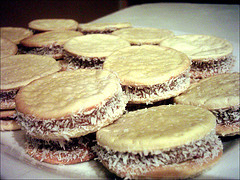
I hadn't made these in a long time. Had to consult with my mom to check that i remembered the recipe right. Plus, it took me a while, because i multiplied by five (otherwise would have gotten some 20 alfajores; way too few!). Tja... They turned out ok, but it was more fun to watch my mom make them. The excitement! To eat bits of the raw dough, spoon out the last of the dulce de leche from its jar, get up at siesta time, in the heat, and tiptoe to the kitchen to steel a couple of freshly made alfajores from the fridge...
Anyway, i've spent most of the day trying to make alfajores de maicena. My mom used to make them for all our birthdays when we were kids, and i thought i'd kill two birds with one stone: make some for the party tonight, and some for this other gathering there is on Monday, to celebrate the end of the norwegian course.
This is the recipe:
100 g. butter
150 g. sugar
2 egg yolks
1 egg white
grated lemon peel (half a lemon)
150 g. corn starch (maizena)
60 g. flour
1 teaspoon baking powder
250 g. de dulce de leche
3 tablespoons grated coconut
You basically beat the butter together with the sugar till you get a creamy mix. Then add the yolks, egg white and lemon peel, beating all the while. Sift in the starch, flour and baking powder, mix, and then start kneading with your hands until you have a nice, homogenous dough. Let it rest for 15 minutes. Then you sprinkle some flour on the table and stretch the dough over it with a rolling pin, till it's about 1/2 cm thick. Cut out circles with a drinking glass (you pick the size; just make sure they're all the same, and that you end up with an even number of circles).
Place these "cookies" on a baking sheet (don't forget the baking paper beneath), and give them 15 minutes at medium heat. You should take them out just as they begin to change color. Let them cool before you peel them off the sheet; otherwise they might break easily.
Make a 'sandwich' with two cookies, by spreading dulce de leche (Hapå, if you're in Norway; don't use too much!) on the flat side of one, and then sticking it to the flat side of another. Some of the dulce de leche will come out on the sides; that's all right. Now roll the cookies around in the coconut and it will stick to the edges, and voilá! Alfajores de maizena.

I hadn't made these in a long time. Had to consult with my mom to check that i remembered the recipe right. Plus, it took me a while, because i multiplied by five (otherwise would have gotten some 20 alfajores; way too few!). Tja... They turned out ok, but it was more fun to watch my mom make them. The excitement! To eat bits of the raw dough, spoon out the last of the dulce de leche from its jar, get up at siesta time, in the heat, and tiptoe to the kitchen to steel a couple of freshly made alfajores from the fridge...
Thursday, November 09, 2006
The war against terror in Argentina
My dad sent me this funny e-mail. It's a spoof, obviously, argentinean in origin, but it says a lot about life in there...
Washington DC, CNN Special, 11.07.2006, 11:30 a.m.
Secret documents recently made public by the FBI revealed that Al Qaeda had planned to sabotage the Summit of the Americas that took place in Mar del Plata, Argentina, in November of last year. Osama Bin Laden had ordered two experienced terrorists of his organization to hijack a plane and crash it against the Casa Rosada (Argentina's equivalent of the White House), in repudiation of George Bush's attendance to the summit.
According to the records of several secret services offices, the two terrorists arrived in Ezeiza International Airport on Sunday, October 30, at 21:45, on an Air France flight from Paris.
However, their mission meets obstacles from the start, as the terrorists find out that their luggage has been sent to Santiago de Chile by mistake. After some five hours of form-filling and being redirected from office to office, unable to communicate with anyone due to their poor command of Argentinean Spanish, the two individuals are advised to return with an interpreter the following day. They leave the airport at around 3:00 on Monday.
They take a taxi to the city center. The driver, upon noticing that they are foreigners, drives them around for three hours and finally abandons them near the shanty town Villa 31, where three criminals (presumably in league with the taxi driver) rob them at gun point.
The two radicals have managed to retain a few dollars hidden in pouches on the inner side of their belts. They bribe a truck driver with some of it, and the man agrees to take them to a less inhospitable part of the city.
On Monday at 7:30 am, and thanks to the guerrilla training they have acquired in Afghanistan, they manage to jump onto a train and arrive at a hotel in Plaza Once. Subsequently, they rent a car and head again for the airport, determined to hijack a Boeing 747, as planned.
However, since route 39 has been cut by piqueteros, public employees and teachers on strike, the two men are delayed a further three hours. When they finally get to the airport, they are involved in an altercation with the car-rental company, as their insurance policy does not cover the severe dents nor the broken windshield which resulted when the pair attempted to push their way through the strikers' march.
Since they are denied entrance to the airport unless the damage to the car is paid, they return to the city at 12:30, looking for a money exchange office. They do not realize they have been given false banknotes until they drop one in a beggar's tin can, and he spits in their faces.
Finally out of options, the two men have to give up on their original plan and decide to settle for Aeroparque Jorge Newbery. Although equipped only for national flights and thus housing much smaller airplanes, it is within walking distance, and they head towards it at 13:25.
When they arrive there at 15:10, they find themselves in the midst of another protest, this time involving the workers of Aerolíneas Argentinas, who are complaining about new regulations proposing to cut the leg room in the pilot and co-pilot seats so that a new row of passenger seats can be added. The only plane on the runway is one belonging to Aerolíneas' rival company, Austral, but due to a strike of the oil industry it has no fuel in its tanks.
Thought part of the mob of passengers and workers that is wreaking havoc in the airport hall, the two men are among those arrested by the airport police. Taken to Police Station number 54 in the Caballito area, they manage to escape after recovering from the effects of the tear gas and the concussion suffered by one of them at the time of the arrest. The time is 19:00, which coincides with guard turnover at the aforementioned station. Apparently, bribing is also involved in the incident, although it is unclear what the two men could have offered the corrupt policemen, as they no longer had any money with them.
A waiter at a famous restaurant reports two foreign men "dirty, beaten-up and walking funny, kind of bow-legged" begging for scraps at closing time that evening, but the next ascertainable notice of the would-be terrorists is on the morning of Tuesday at 4:30, when they arrive to Hospital Casa de Mayo with a severe case of food poisoning. As there are no beds available, they are driven to four other hospitals, and finally admitted in Hospital Regal at 9:40.
They are released on Sunday at 17:30. Though each of them is missing a kidney, they are now in possession of some cash again, having made a deal with the head physician at that health center.
Since by this time the summit is over, they attempt to leave the country. They buy a bus ticket to Asunción del Paraguay, but when the engine breaks near the city of Rosario, the bus is broken into by a band of highway robbers. Excepting underwear, all passenger possessions are taken away.
In pain, hungry and desperate, they fall asleep in the hallway of an electro-domestics warehouse in a Rosario suburb. Taken in by an ONG with hidden Catholic roots, they spend the next three months at a rural community in La Pampa, where they are fed and allowed to work in exchange for learning and reciting the psalms.
As they recover their strength, they manage to escape and in May of this year walk into the Central Police Station of Buenos Aires. As foreigners lacking documents, they are deported, mysteriously avoiding further physical abuse. "They said they were carriers of an extremely contagious kind of STD", reported an officer.
Washington congratulated President Kirchner on the country's excellent security. "Although the two men managed to get away" said A.D. Ashley, head of the FBI, "the deterrent measures deployed within all levels of Argentinean society make of that country a model to be followed by our allies in the war against terror."
Washington DC, CNN Special, 11.07.2006, 11:30 a.m.
Secret documents recently made public by the FBI revealed that Al Qaeda had planned to sabotage the Summit of the Americas that took place in Mar del Plata, Argentina, in November of last year. Osama Bin Laden had ordered two experienced terrorists of his organization to hijack a plane and crash it against the Casa Rosada (Argentina's equivalent of the White House), in repudiation of George Bush's attendance to the summit.
According to the records of several secret services offices, the two terrorists arrived in Ezeiza International Airport on Sunday, October 30, at 21:45, on an Air France flight from Paris.
However, their mission meets obstacles from the start, as the terrorists find out that their luggage has been sent to Santiago de Chile by mistake. After some five hours of form-filling and being redirected from office to office, unable to communicate with anyone due to their poor command of Argentinean Spanish, the two individuals are advised to return with an interpreter the following day. They leave the airport at around 3:00 on Monday.
They take a taxi to the city center. The driver, upon noticing that they are foreigners, drives them around for three hours and finally abandons them near the shanty town Villa 31, where three criminals (presumably in league with the taxi driver) rob them at gun point.
The two radicals have managed to retain a few dollars hidden in pouches on the inner side of their belts. They bribe a truck driver with some of it, and the man agrees to take them to a less inhospitable part of the city.
On Monday at 7:30 am, and thanks to the guerrilla training they have acquired in Afghanistan, they manage to jump onto a train and arrive at a hotel in Plaza Once. Subsequently, they rent a car and head again for the airport, determined to hijack a Boeing 747, as planned.
However, since route 39 has been cut by piqueteros, public employees and teachers on strike, the two men are delayed a further three hours. When they finally get to the airport, they are involved in an altercation with the car-rental company, as their insurance policy does not cover the severe dents nor the broken windshield which resulted when the pair attempted to push their way through the strikers' march.
Since they are denied entrance to the airport unless the damage to the car is paid, they return to the city at 12:30, looking for a money exchange office. They do not realize they have been given false banknotes until they drop one in a beggar's tin can, and he spits in their faces.
Finally out of options, the two men have to give up on their original plan and decide to settle for Aeroparque Jorge Newbery. Although equipped only for national flights and thus housing much smaller airplanes, it is within walking distance, and they head towards it at 13:25.
When they arrive there at 15:10, they find themselves in the midst of another protest, this time involving the workers of Aerolíneas Argentinas, who are complaining about new regulations proposing to cut the leg room in the pilot and co-pilot seats so that a new row of passenger seats can be added. The only plane on the runway is one belonging to Aerolíneas' rival company, Austral, but due to a strike of the oil industry it has no fuel in its tanks.
Thought part of the mob of passengers and workers that is wreaking havoc in the airport hall, the two men are among those arrested by the airport police. Taken to Police Station number 54 in the Caballito area, they manage to escape after recovering from the effects of the tear gas and the concussion suffered by one of them at the time of the arrest. The time is 19:00, which coincides with guard turnover at the aforementioned station. Apparently, bribing is also involved in the incident, although it is unclear what the two men could have offered the corrupt policemen, as they no longer had any money with them.
A waiter at a famous restaurant reports two foreign men "dirty, beaten-up and walking funny, kind of bow-legged" begging for scraps at closing time that evening, but the next ascertainable notice of the would-be terrorists is on the morning of Tuesday at 4:30, when they arrive to Hospital Casa de Mayo with a severe case of food poisoning. As there are no beds available, they are driven to four other hospitals, and finally admitted in Hospital Regal at 9:40.
They are released on Sunday at 17:30. Though each of them is missing a kidney, they are now in possession of some cash again, having made a deal with the head physician at that health center.
Since by this time the summit is over, they attempt to leave the country. They buy a bus ticket to Asunción del Paraguay, but when the engine breaks near the city of Rosario, the bus is broken into by a band of highway robbers. Excepting underwear, all passenger possessions are taken away.
In pain, hungry and desperate, they fall asleep in the hallway of an electro-domestics warehouse in a Rosario suburb. Taken in by an ONG with hidden Catholic roots, they spend the next three months at a rural community in La Pampa, where they are fed and allowed to work in exchange for learning and reciting the psalms.
As they recover their strength, they manage to escape and in May of this year walk into the Central Police Station of Buenos Aires. As foreigners lacking documents, they are deported, mysteriously avoiding further physical abuse. "They said they were carriers of an extremely contagious kind of STD", reported an officer.
Washington congratulated President Kirchner on the country's excellent security. "Although the two men managed to get away" said A.D. Ashley, head of the FBI, "the deterrent measures deployed within all levels of Argentinean society make of that country a model to be followed by our allies in the war against terror."
Wednesday, November 08, 2006
Tuesday, November 07, 2006
Another one
Well, it just seems like supposed plans of mine keep being blasted into the air -- by non other than me, of course. POWERRRRRR!
Yesterday evening i was talking to my friend José, who's getting married in Uruguay in march. We were talking about how nice it'd be to take a trip in the Patagonia in January, before he ties the knot... And i realized the idea fits perfectly!
I'll be finished with my intermediate norwegian course in December, then go to Spain to spend xmas and new year with my brother. After that, off to Argentina for six months! Will spend a good deal of time with my family, plus travel, attend the wedding, maybe get a little involved in anti-mining activism...
Bought the tickets already.
Now i have to go to the u and give them back the piles of books i'd been taking out. It's gonna take at least 5 trips...
Phew!
Yesterday evening i was talking to my friend José, who's getting married in Uruguay in march. We were talking about how nice it'd be to take a trip in the Patagonia in January, before he ties the knot... And i realized the idea fits perfectly!
I'll be finished with my intermediate norwegian course in December, then go to Spain to spend xmas and new year with my brother. After that, off to Argentina for six months! Will spend a good deal of time with my family, plus travel, attend the wedding, maybe get a little involved in anti-mining activism...
Bought the tickets already.
Now i have to go to the u and give them back the piles of books i'd been taking out. It's gonna take at least 5 trips...
Phew!
Monday, November 06, 2006
SNORE!
I talked to my teachers today. Told them exactly what i wrote in here over the weekend. They weren't too happy about my quitting, but not nasty, either. I suppose it's unconventional, but it feels like the right thing to do right now. Can, the guy next door, said i was just being lazy; i liked his honesty. Not that i agree with the judgement, but i suppose it can be seen that way. I'm definitely not planning to just sit and twiddle my fingers for the next year and a half; i just don't want to go ahead with this masters program.
I also hope i won't have to live on fish alone, either, as Minge suggested: fishing bores me, and i'd probably starve before i catch any.
Wondering: by quitting like this, am i setting a bad example for my ex-students? I know some of you guys read this... Funny how i used to worry that my not quitting something was a bad example (smoking) and now quitting something else still causes that kind of reaction in me.
Wondering: is the patronizing, ego-inflated attitude behind such a reaction something that comes with being a teacher, or is it just me? As if my actions had such influence over the decisions of people that can think and reason by themselves!
Anyway, it's late. Going to sleep.
I also hope i won't have to live on fish alone, either, as Minge suggested: fishing bores me, and i'd probably starve before i catch any.
Wondering: by quitting like this, am i setting a bad example for my ex-students? I know some of you guys read this... Funny how i used to worry that my not quitting something was a bad example (smoking) and now quitting something else still causes that kind of reaction in me.
Wondering: is the patronizing, ego-inflated attitude behind such a reaction something that comes with being a teacher, or is it just me? As if my actions had such influence over the decisions of people that can think and reason by themselves!
Anyway, it's late. Going to sleep.
Sunday, November 05, 2006
Coming out
Interesting video:
http://www.insideimdancing.com/blog/2006/07/my-closet-is-only-full-of-clothes-now.html#comments
A guy talks about his experience coming out to his parents.
http://www.insideimdancing.com/blog/2006/07/my-closet-is-only-full-of-clothes-now.html#comments
A guy talks about his experience coming out to his parents.
La luna llena
La luna llena salió a las dos de la tarde.
La luna, llena y presente.
La gorda luna llena recién salida.
La luna llena salió en el noroeste.
La luna llena sobre las montañas nevadas.
La luna llena, blanca.
La luna llena y el sol aún sin ponerse.
La luna llena y blanca y el sol que hacía rosa la nieve.
La luna llena a mis espaldas.
La luna llena y yo viajando en bus.
La luna llena ahora en el cielo oscuro.
La luna llena, que parte el fiordo negro en dos.
La luna llena que borra las estrellas.
La luna llena que me llena la ventana.
La luna llena que me llama.
La luna, llena y presente.
La gorda luna llena recién salida.
La luna llena salió en el noroeste.
La luna llena sobre las montañas nevadas.
La luna llena, blanca.
La luna llena y el sol aún sin ponerse.
La luna llena y blanca y el sol que hacía rosa la nieve.
La luna llena a mis espaldas.
La luna llena y yo viajando en bus.
La luna llena ahora en el cielo oscuro.
La luna llena, que parte el fiordo negro en dos.
La luna llena que borra las estrellas.
La luna llena que me llena la ventana.
La luna llena que me llama.
Saturday, November 04, 2006
Decisions, decisions...
Hmmmm. I think i'm gonna leave the masters program at UiTø. I want to stay in Tromsø, and continue with my norwegian lessons, but the whole point of me taking a couple of years away from Flekke was that i was tired, and that i wanted to do something different, and relax... But here i am, squeezing my brains trying to understand this very technical stuff, spending hours in front of the computer, writing essay upon essay. Interesting as it all is, it's definitely not what i want to be doing right now. So, ha det bra.
Of course, it's not as easy as that. I have to start looking for a new place, 'cause if i'm not a student at the u, i can't keep living in the cheap dorm; i have to quit my norwegian classes at the u and change to the course taught at voksenopplæring senteret, because the one at the u is for students only; i'll have to find some kind of job in town, too, so as not to eat up all my savings; then there is the move to organize...
Doesn't sound very relaxing, either, but here i am, and these are the choices. Yup, i think that's that for the masters. Thanks for all the fish.
Of course, it's not as easy as that. I have to start looking for a new place, 'cause if i'm not a student at the u, i can't keep living in the cheap dorm; i have to quit my norwegian classes at the u and change to the course taught at voksenopplæring senteret, because the one at the u is for students only; i'll have to find some kind of job in town, too, so as not to eat up all my savings; then there is the move to organize...
Doesn't sound very relaxing, either, but here i am, and these are the choices. Yup, i think that's that for the masters. Thanks for all the fish.
The Language Instinct
I'm reading this book by Steven Pinker. Check out this passage:
Consider an alleged atrocity committed by today's youth: the expression I could care less. The teenagers are trying to express disdain, the adults note, in which case they should be saying I couldn't care less. If they could care less than they do, that means that they really do care, the opposite of what they're trying to say. But if these dudes would stop ragging on teenagers and scope out the construction, they would see that their argument is bogus. Listen to how the two versions are pronounced:
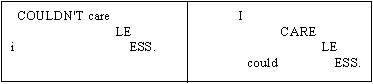
The melodies and stresses are completely different, and for a good reason. The second version is not illogical, it's sarcastic. The point of sarcarsm is that by making an assertion that is manifestly false or accompanied by ostentatiously mannered intonation, one deliberately implies its opposite. A good paraphrase is, "Oh yeah, as if there was something in the world I care less about."
Consider an alleged atrocity committed by today's youth: the expression I could care less. The teenagers are trying to express disdain, the adults note, in which case they should be saying I couldn't care less. If they could care less than they do, that means that they really do care, the opposite of what they're trying to say. But if these dudes would stop ragging on teenagers and scope out the construction, they would see that their argument is bogus. Listen to how the two versions are pronounced:
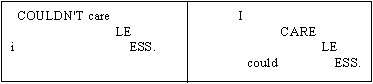
The melodies and stresses are completely different, and for a good reason. The second version is not illogical, it's sarcastic. The point of sarcarsm is that by making an assertion that is manifestly false or accompanied by ostentatiously mannered intonation, one deliberately implies its opposite. A good paraphrase is, "Oh yeah, as if there was something in the world I care less about."
Vladimir Nabokov
Lolita, light of my life, fire of my loins. My sin, my soul. Lo-lee-ta: the tip of the tongue taking a trip of three steps down the palate to tap, at three, on the teeth. Lo. Lee. Ta.
Dr. Seuss
And NUH is the letter I use to spell Nutches
Who live in small caves, known as Nitches, for hutches.
These Nutches have troubles, the biggest of which is
The fact there are many more Nutches than Nitches.
Each Nutch in a Nitch knows that some other Nutch
Would like to move into his Nitch very much.
So each Nutch in a Nitch has to watch that small Nitch
Or Nutches who haven't got Nitches will snitch.
Who live in small caves, known as Nitches, for hutches.
These Nutches have troubles, the biggest of which is
The fact there are many more Nutches than Nitches.
Each Nutch in a Nitch knows that some other Nutch
Would like to move into his Nitch very much.
So each Nutch in a Nitch has to watch that small Nitch
Or Nutches who haven't got Nitches will snitch.
Friday, November 03, 2006
La buona novella II
This is another fragment of de André's "Good News". In it Mary tells Joseph about her conception of Jesus.
"In the womb of the temple, wet and dark dark,
the shadows were cold, incense-swollen;
the angel came down, like every evening,
to teach me a new prayer.
Then, suddenly, he unclasped my hands
and my arms became wings.
When he asked me "Do you know the summer?"
I ran, for a day, for an instant,
to see the color in the wind.
We truly flew, over the houses,
beyond gates, gardens and streets.
Then we slid among valleys in bloom
where grapevines hug olive trees.
We came down there, where the day gets lost
looking for itself in the greenery.
The angel spoke, as if praying,
and at the end of each prayer
he counted out a vertebra in my spine.
The priests's long shadows
pushed the dream into a circle of voices.
I thought to escape with my wings from before
but my arms were naked, and i could not fly.
Then i saw the angel become a comet
and the severe faces became stone,
their arms, the outline of branches
in the still postures of another kind of life:
their hands, leaves; their fingers, thorns.
Voices from the street, the sounds of people,
stole me from the dream and gave me back to the present.
The image vanished, color was extinguished,
but the far away echo of short words
repeated the strange prayer of an angel.
Maybe it was a dream, but it wasn't sleep.
"They'll call him the son of God."
Blurry words in my mind,
vanished in the dream, but present in my womb."
And the words, tired,
dissolved into tears.
The fear in the lips
was collected in the eyes
half-closed in the semblance
of a calmness
that is actually burning up, waiting
for an indulgent look.
And you slowly placed your fingers
at the edge of her forehead:
when they caress, old people
are afraid of being too rough.
"In the womb of the temple, wet and dark dark,
the shadows were cold, incense-swollen;
the angel came down, like every evening,
to teach me a new prayer.
Then, suddenly, he unclasped my hands
and my arms became wings.
When he asked me "Do you know the summer?"
I ran, for a day, for an instant,
to see the color in the wind.
We truly flew, over the houses,
beyond gates, gardens and streets.
Then we slid among valleys in bloom
where grapevines hug olive trees.
We came down there, where the day gets lost
looking for itself in the greenery.
The angel spoke, as if praying,
and at the end of each prayer
he counted out a vertebra in my spine.
The priests's long shadows
pushed the dream into a circle of voices.
I thought to escape with my wings from before
but my arms were naked, and i could not fly.
Then i saw the angel become a comet
and the severe faces became stone,
their arms, the outline of branches
in the still postures of another kind of life:
their hands, leaves; their fingers, thorns.
Voices from the street, the sounds of people,
stole me from the dream and gave me back to the present.
The image vanished, color was extinguished,
but the far away echo of short words
repeated the strange prayer of an angel.
Maybe it was a dream, but it wasn't sleep.
"They'll call him the son of God."
Blurry words in my mind,
vanished in the dream, but present in my womb."
And the words, tired,
dissolved into tears.
The fear in the lips
was collected in the eyes
half-closed in the semblance
of a calmness
that is actually burning up, waiting
for an indulgent look.
And you slowly placed your fingers
at the edge of her forehead:
when they caress, old people
are afraid of being too rough.
La buona novella
Fabrizio de André is my favorite italian composer and singer. In this fragment of "The Good News", an album he made in 1970, he has one of the thieves crucified with Jesus talk about the 10 commandments.
"You will not have other gods beside me"
has often made me think:
others, from the east,
said that it didn't make any difference.
They believed in someone else
and they didn't hurt me.
They believed in someone else
and they didn't hurt me.
"Do not use the name of the Lord,
do not use it in vain."
With a knife stuck on my side
i screamed my suffering and his name:
but maybe he was tired, maybe too busy,
and he didn't hear my pain.
But maybe he was tired, maybe too far away,
i really did it in vain.
"Honour your father, honour your mother
and honour their staffs, too."
Kiss the hand that broke your nose
because you were asking for food:
When my father's heart stopped
i didn't feel pain.
When my father's heart stopped
i didn't feel pain.
"Remember to sanctify the holidays."
It's easy, for us thieves,
to go into the temples that vomit psalms
of slaves and their masters
without ending up tied up to the altars,
our necks slit, like animals.
Without ending up tied up to the altars,
our necks slit, like animals.
The fifth says "You must not steel"
and perhaps i've respected it
by emptying in silence the swollen pockets
of those who had stolen:
but i, lawless, stole in my name;
they did it in the name of God.
But i, lawless, stole in my name;
they did it in the name of God.
"Do not commit impure acts"
that is to say, don't waste your seed.
Make a woman pregnant every time you love her
and thus you'll be a man of faith:
then lust is gone, and the child remains
and many are killed by hunger.
Maybe i've mistaken pleasure for love
but i haven't created pain.
The seventh says "do not kill
if you want to be worthy of heaven."
Look at this law of God, today,
three times nailed to a cross:
look at the death of this nazarene
and still, not a thieve less dies.
Look at the death of this nazarene
and still, not a thieve less dies.
"Do not raise false testimony"
and help them kill a man.
They know divine law by heart
and always forget forgiveness:
i have denied God and my honour
and no, i don't feel pain.
I have denied God and my honour
and no, i don't feel pain.
"Do not covet what belongs to others,
do not covet their wife."
Say that to them, ask those few
that have a woman and something:
in other's beds, warm with love,
i didn't feel pain.
Yesterday's envy is not over:
tonight i envy your life.
But now that night and darkness come
they take the pain away from my eyes
and the sun glides beyond the dunes
to rape other nights:
in seeing this man, dying
i feel pain, mother.
In compassion that doesn't give in to resentment
i have learned love, mother.
(For the italian original, you can go to http://www.frascolla.org/FDA/t04.htm ).
"You will not have other gods beside me"
has often made me think:
others, from the east,
said that it didn't make any difference.
They believed in someone else
and they didn't hurt me.
They believed in someone else
and they didn't hurt me.
"Do not use the name of the Lord,
do not use it in vain."
With a knife stuck on my side
i screamed my suffering and his name:
but maybe he was tired, maybe too busy,
and he didn't hear my pain.
But maybe he was tired, maybe too far away,
i really did it in vain.
"Honour your father, honour your mother
and honour their staffs, too."
Kiss the hand that broke your nose
because you were asking for food:
When my father's heart stopped
i didn't feel pain.
When my father's heart stopped
i didn't feel pain.
"Remember to sanctify the holidays."
It's easy, for us thieves,
to go into the temples that vomit psalms
of slaves and their masters
without ending up tied up to the altars,
our necks slit, like animals.
Without ending up tied up to the altars,
our necks slit, like animals.
The fifth says "You must not steel"
and perhaps i've respected it
by emptying in silence the swollen pockets
of those who had stolen:
but i, lawless, stole in my name;
they did it in the name of God.
But i, lawless, stole in my name;
they did it in the name of God.
"Do not commit impure acts"
that is to say, don't waste your seed.
Make a woman pregnant every time you love her
and thus you'll be a man of faith:
then lust is gone, and the child remains
and many are killed by hunger.
Maybe i've mistaken pleasure for love
but i haven't created pain.
The seventh says "do not kill
if you want to be worthy of heaven."
Look at this law of God, today,
three times nailed to a cross:
look at the death of this nazarene
and still, not a thieve less dies.
Look at the death of this nazarene
and still, not a thieve less dies.
"Do not raise false testimony"
and help them kill a man.
They know divine law by heart
and always forget forgiveness:
i have denied God and my honour
and no, i don't feel pain.
I have denied God and my honour
and no, i don't feel pain.
"Do not covet what belongs to others,
do not covet their wife."
Say that to them, ask those few
that have a woman and something:
in other's beds, warm with love,
i didn't feel pain.
Yesterday's envy is not over:
tonight i envy your life.
But now that night and darkness come
they take the pain away from my eyes
and the sun glides beyond the dunes
to rape other nights:
in seeing this man, dying
i feel pain, mother.
In compassion that doesn't give in to resentment
i have learned love, mother.
(For the italian original, you can go to http://www.frascolla.org/FDA/t04.htm ).
Wednesday, November 01, 2006
Conversation
-Do you know what time it is?- i asked.
-I was just reading a book- he answered.
-What is it about?- i tried.
-Wow! It's almost three! Gotta run to class!- and off he was.
-I was just reading a book- he answered.
-What is it about?- i tried.
-Wow! It's almost three! Gotta run to class!- and off he was.
Idiom
Why should someone shit bricks when they're scared? I'd become scared if i shat bricks, not the other way around!
La Traviata
Here's a fragment of Verdi's La Traviata. The melody has been ringing in my head all day long. Thought it'd be nice to translate it and post it here:
Folly! Folly!
A vane craze this is!
Poor woman,
alone,
abandoned,
in this populous desert they call Paris.
What is there to wait for, anymore?
What must i do?
Just seek pleasure
and perish in the turmoil.
I must be always free,
stumble from joy to joy.
I want my living to flow
through the paths of pleasure.
Both when the day is born and when it dies
enjoyment is always to be found.
To delights always new
must my thought fly.
Folly! Folly!
A vane craze this is!
Poor woman,
alone,
abandoned,
in this populous desert they call Paris.
What is there to wait for, anymore?
What must i do?
Just seek pleasure
and perish in the turmoil.
I must be always free,
stumble from joy to joy.
I want my living to flow
through the paths of pleasure.
Both when the day is born and when it dies
enjoyment is always to be found.
To delights always new
must my thought fly.
Hvorfor ikke?
Someone had written this in the snow outside my house:

I can think of many answers:
Because the snow melts.
Because someone will step on it.
Because more snow will cover it.
Because the snow plough will plough it away.
But the one i like most is:
Indeed! Why not?
I imagine how it must have felt, to dip a finger in the snow and carve the words out. Who cares what becomes of them?

I can think of many answers:
Because the snow melts.
Because someone will step on it.
Because more snow will cover it.
Because the snow plough will plough it away.
But the one i like most is:
Indeed! Why not?
I imagine how it must have felt, to dip a finger in the snow and carve the words out. Who cares what becomes of them?
Voices in the head
Does it ever happen to you that you hear other people's voices in your head? Like you carry those people inside you?
Seriously. Sometimes, when i'm wondering about a situation, or experiencing something particularly intense, or when i have to take a decision, i can distinctly hear what such-and-such friend or relative would say about it. I don't call them, either. Their opinions just pop up and vanish, and i'm left with that nice feeling one gets after a surprise. Yeah, i'm thrilled by the unexpectedness of it, because sometimes i totally disagree with what they say. I would argue with them about it, but they're gone before i can grab them.
This morning, while i was freezing at the busstop, my grandma, dead 11 years, told me i should have put on a scarf. Just like that, out of the blue -- or the grey, as it was actually very overcast and snowing. Then zap!, she was gone, and i realized i couldn't even remember how her voice really sounded. She used to fuzz about our clothing like that, when we were kids. I hadn't thought about her in a while.
It'd be nice to think that we carry inside at least pieces of the people who are or have been close to us. Whether we got along or not. Of course, my skeptical mind says that when i hear these voices, i'm simply having my brain play a game, assigning identities to my own points of view, for one reason or another. I'm very fond of my skeptical mind, and trust her a lot.
Yet, i like the poetry of the other image, the possibilities it opens. If i have people in my head, then maybe i'm in other's people's heads, too... Even inside the head of the people inside my head... And the me inside the heads of the people inside my head has other people inside his head, and it's all like a matrioshka doll, except that instead of dolls people's heads hold universes within themselves.
If i could communicate at will with the people inside my head, they might tell me "look, i don't have time to argue with you, i have all these people inside my head i need to talk to". As it is, i just catch glimpses of their interiors, and that's why thankfully there's also a universe outside of our heads, with people i can talk to and get near to and love... And yet be as far from knowing their internal universes as i am from knowing my own. On the other hand, if i didn't know them at least a little, i wouldn't be able to imagine what they would say in my head, which is heartening.
Got to go to norwegian class. Don't bother to call the insane asylum, as i already did. They're reinforcing their straight jackets, and coming for me this evening.
Seriously. Sometimes, when i'm wondering about a situation, or experiencing something particularly intense, or when i have to take a decision, i can distinctly hear what such-and-such friend or relative would say about it. I don't call them, either. Their opinions just pop up and vanish, and i'm left with that nice feeling one gets after a surprise. Yeah, i'm thrilled by the unexpectedness of it, because sometimes i totally disagree with what they say. I would argue with them about it, but they're gone before i can grab them.
This morning, while i was freezing at the busstop, my grandma, dead 11 years, told me i should have put on a scarf. Just like that, out of the blue -- or the grey, as it was actually very overcast and snowing. Then zap!, she was gone, and i realized i couldn't even remember how her voice really sounded. She used to fuzz about our clothing like that, when we were kids. I hadn't thought about her in a while.
It'd be nice to think that we carry inside at least pieces of the people who are or have been close to us. Whether we got along or not. Of course, my skeptical mind says that when i hear these voices, i'm simply having my brain play a game, assigning identities to my own points of view, for one reason or another. I'm very fond of my skeptical mind, and trust her a lot.
Yet, i like the poetry of the other image, the possibilities it opens. If i have people in my head, then maybe i'm in other's people's heads, too... Even inside the head of the people inside my head... And the me inside the heads of the people inside my head has other people inside his head, and it's all like a matrioshka doll, except that instead of dolls people's heads hold universes within themselves.
If i could communicate at will with the people inside my head, they might tell me "look, i don't have time to argue with you, i have all these people inside my head i need to talk to". As it is, i just catch glimpses of their interiors, and that's why thankfully there's also a universe outside of our heads, with people i can talk to and get near to and love... And yet be as far from knowing their internal universes as i am from knowing my own. On the other hand, if i didn't know them at least a little, i wouldn't be able to imagine what they would say in my head, which is heartening.
Got to go to norwegian class. Don't bother to call the insane asylum, as i already did. They're reinforcing their straight jackets, and coming for me this evening.
Homework
Due in 6 hours. I suppose i should have started a little earlier. As it was, i just took a verbal laxative and let it all flow out... You can tell, i'm sure.
QUESTION 2: The Critical Period
One of the arguments for the biological foundation of linguistic knowledge is the notion of critical period. First, explain what is meant by critical period and provide examples from the natural world to demonstrate your point. Then explain how the notion has been expanded to apply to language and what kinds of arguments have been used to do so. Finally, give an evaluation of the validity of this argument in relation to language.
As the name implies, a critical period defines a limited window of time within which a certain event or chain of events must occur, and outside of which they cannot. When applied in the field of First Language Acquisition, as proposed by Wilder Penfield (1959), Steven Pinker (1994) and others, "critical period" refers to the idea that there exists in people's lives a time beyond which a native-like acquisition of language becomes impossible.
The implications of this concept will be elaborated and explored later in the paper. As an introduction to that, however, it is important to consider other natural processes, taking place in the animal world, which must be accomplished within a critical period. The fact that they are biological is fundamental to our analysis, because if an analogy can be established between them and the process of language acquisition, an argument can be made for the presence of an implicit, biologically based 'ability' for language in human beings.
As noted by Thorpe (1958), one very clear case of the existence of a critical period within which a capability must be "initialized" in the animal realm is that concerning the chaffinch's command of its singing. This bird, which is capable of producing a characteristic and very systematic song, will never properly perform it unless it hears it before reaching maturity. Likewise, as pointed out by Lorenz (1970), greylag geese can only be imprinted, and their imprinting changed, within the first 36 hours of their birth; after that, it becomes impossible.
Thus, although the susceptibility to being imprinted and the ability to sing a specific song are physiologically inherent in these creatures, it is apparent that both must be cued and stimulated during a certain, early period of their lives for the innate potentialities to properly manifest themselves. Other processes presenting these characteristics are the acquisition of binocular vision in children (Almli et al. (1987)), which fails to appear if not used between one and three years of age, and of the vestibular system, at least as far zebrafish go (Moorman et al. (2002)).
These facts, although they clearly attest that there are critical periods which bear on the manifestation or lack thereof of genetically coded capabilities in other animals and even in humans, do not directly prove the theory about the existence of such a period for language acquisition. Nevertheless, they serve as a point of analogy and make evident the fact that it is exposure and/or exercise of certain organs or innate abilities that determine their functioning or manifestation in later life.
Incontrovertible evidence for the existence of a critical period in language acquisition could be provided by a comparative study of adults who had been exposed to language at different stages of childhood and adolescence. If, regardless of environment, intensity of exposure and teaching methods, an inferiority in the language command of those who were exposed later could be detected, it would become very difficult to think of theories that accounted for this fact other than the critical period one.
Fortunately, language is such an undissociatable part of being human that most children are exposed to it from birth, in one way or another. So called feral children, who have been kept away from all human contact from a very young age, are very rare – only a hundred or so have ever been reported and, indeed, it has proven very difficult for them to acquire language. However, the isolation they suffered resulted also, almost invariably, in an inability to acquire other traits that are usually thought of as inherently human, like walking "properly", or in social behavior difficult to judge other than as impaired by any cultural standard. Whereas these facts might indicate that language is not the only process with cognitive associations that is sensitive to a critical period, often they have also served to cast doubts on the mental health of these children (Newton (2002)). Thus, it has been argued that the reason for their failure to acquire a proper command of language lies in innate brain defects, and not in an expired critical period. Nevertheless, it is equally possible to argue that, even if such children were to show differences in brain activity and/or development in the most modern medical tests, we would be hard pressed to say whether the damage was a birth defect or a result of failure to meet those critical windows with the appropriate input.
A case in point is that of Genie, who was isolated, restrained and punished if she made any noise until the age of thirteen and a half. Being the most recent and dramatic case of a feral child, mention of her is very common in all language acquisition literature that deals with the critical period theory. Although the same questions are pondered as to her possible brain defects, a particular fact about her allows us to finesse this discussion: Genie had practically no language at all when she was discovered, yet she soon learned many words, and began to string them together; however, these sentences were very short, and contained very gross syntax violations (Pinker (1994)). She never got past this stage. A similar case is that of Chelsea, who only at 31 got a hearing aid to compensate for her deafness. Though provenly normal at the emotional and neurological levels, she was never exposed to any form of language till then. And like Genie, although she quickly acquired a rich vocabulary, her syntax remained extremely bizarre (IDEM (1994).
The facts examined to this point support quite strongly the view that a critical period exists, if nothing else, for syntax acquisition. The human brain seems to include a 'skeleton' on which syntax is to grow, which must be exercised within a certain age. Other indications of it are found in the study of deaf children who begin acquiring sign language at a very early age from deaf adults who only acquired it in their teens (Singleton et al.(2004)). In these cases, the children are better able to absorb the correct grammatical rules and set parameters to the right value, even when they have no interaction with other second generation speakers. This means that when exposed to language at this age, but not later, they are able to pick right from the inconsistent input around them.
Even more revealing are those studies that have explored the transition from pidgins, which tend to be mere collections of vocabulary that do no have any organized grammatical order, into creoles, which do. Pidgins are usually created when adults that do not share a common language are thrown together and must find some means of communication, but the first generation of children that is born into a pidgin-speaking society (or, presumably, introduced to the pidgin within the critical period), almost instantly transform the haphazard collection of words into a creole, rich in grammatical rules and consistent with them. This happens whether the original pidgin is spoken (Bickerton (1992)) or signed (Kegl et al. (1989)), all of which indicates, once more, that children are "geared" to take advantage and be aware of syntax in ways that adults are not.
As for other aspects of language acquisition, such as phonetics and pronunciation, it seems that a critical window of exposure can also be assumed. For instance, it has been noted that, if s/he is exposed after a certain age, the speaker will always have an accent identifiable as non-native, whether s/he is a first or second language learner (Oyama (1982)).
Authors such as Pinker (1994) argue that if introduced to it after the age of six, children's ability to acquire a native-like command of a language, be it first or second, is compromised. If after puberty, normal first language acquisition is unexpected, and if the learner already possesses a first language, the new one will not be as perfectly known.
Personally, I am satisfied that, at least as far as the acquisition of syntax is concerned, there is enough evidence to speak of a critical period. I believe that this is the core of the argument, anyway. After all, the critical period theory, together with the poverty of the stimulus argument, are important mostly in that they support the idea of a Universal Grammar innate in all humans. In this sense, what is important is to prove the existence of a critical period for the first setting of the principles and parameters of a grammar. It may or may not be possible to fully reset those principles and parameters to accommodate a second or third language after a certain age, but this is not so relevant. The same goes for pronunciation, because if a critical period exists for the acquisition of it, this will point, in my opinion, to a set of innate capabilities different from those underlying UG
QUESTION 2: The Critical Period
One of the arguments for the biological foundation of linguistic knowledge is the notion of critical period. First, explain what is meant by critical period and provide examples from the natural world to demonstrate your point. Then explain how the notion has been expanded to apply to language and what kinds of arguments have been used to do so. Finally, give an evaluation of the validity of this argument in relation to language.
As the name implies, a critical period defines a limited window of time within which a certain event or chain of events must occur, and outside of which they cannot. When applied in the field of First Language Acquisition, as proposed by Wilder Penfield (1959), Steven Pinker (1994) and others, "critical period" refers to the idea that there exists in people's lives a time beyond which a native-like acquisition of language becomes impossible.
The implications of this concept will be elaborated and explored later in the paper. As an introduction to that, however, it is important to consider other natural processes, taking place in the animal world, which must be accomplished within a critical period. The fact that they are biological is fundamental to our analysis, because if an analogy can be established between them and the process of language acquisition, an argument can be made for the presence of an implicit, biologically based 'ability' for language in human beings.
As noted by Thorpe (1958), one very clear case of the existence of a critical period within which a capability must be "initialized" in the animal realm is that concerning the chaffinch's command of its singing. This bird, which is capable of producing a characteristic and very systematic song, will never properly perform it unless it hears it before reaching maturity. Likewise, as pointed out by Lorenz (1970), greylag geese can only be imprinted, and their imprinting changed, within the first 36 hours of their birth; after that, it becomes impossible.
Thus, although the susceptibility to being imprinted and the ability to sing a specific song are physiologically inherent in these creatures, it is apparent that both must be cued and stimulated during a certain, early period of their lives for the innate potentialities to properly manifest themselves. Other processes presenting these characteristics are the acquisition of binocular vision in children (Almli et al. (1987)), which fails to appear if not used between one and three years of age, and of the vestibular system, at least as far zebrafish go (Moorman et al. (2002)).
These facts, although they clearly attest that there are critical periods which bear on the manifestation or lack thereof of genetically coded capabilities in other animals and even in humans, do not directly prove the theory about the existence of such a period for language acquisition. Nevertheless, they serve as a point of analogy and make evident the fact that it is exposure and/or exercise of certain organs or innate abilities that determine their functioning or manifestation in later life.
Incontrovertible evidence for the existence of a critical period in language acquisition could be provided by a comparative study of adults who had been exposed to language at different stages of childhood and adolescence. If, regardless of environment, intensity of exposure and teaching methods, an inferiority in the language command of those who were exposed later could be detected, it would become very difficult to think of theories that accounted for this fact other than the critical period one.
Fortunately, language is such an undissociatable part of being human that most children are exposed to it from birth, in one way or another. So called feral children, who have been kept away from all human contact from a very young age, are very rare – only a hundred or so have ever been reported and, indeed, it has proven very difficult for them to acquire language. However, the isolation they suffered resulted also, almost invariably, in an inability to acquire other traits that are usually thought of as inherently human, like walking "properly", or in social behavior difficult to judge other than as impaired by any cultural standard. Whereas these facts might indicate that language is not the only process with cognitive associations that is sensitive to a critical period, often they have also served to cast doubts on the mental health of these children (Newton (2002)). Thus, it has been argued that the reason for their failure to acquire a proper command of language lies in innate brain defects, and not in an expired critical period. Nevertheless, it is equally possible to argue that, even if such children were to show differences in brain activity and/or development in the most modern medical tests, we would be hard pressed to say whether the damage was a birth defect or a result of failure to meet those critical windows with the appropriate input.
A case in point is that of Genie, who was isolated, restrained and punished if she made any noise until the age of thirteen and a half. Being the most recent and dramatic case of a feral child, mention of her is very common in all language acquisition literature that deals with the critical period theory. Although the same questions are pondered as to her possible brain defects, a particular fact about her allows us to finesse this discussion: Genie had practically no language at all when she was discovered, yet she soon learned many words, and began to string them together; however, these sentences were very short, and contained very gross syntax violations (Pinker (1994)). She never got past this stage. A similar case is that of Chelsea, who only at 31 got a hearing aid to compensate for her deafness. Though provenly normal at the emotional and neurological levels, she was never exposed to any form of language till then. And like Genie, although she quickly acquired a rich vocabulary, her syntax remained extremely bizarre (IDEM (1994).
The facts examined to this point support quite strongly the view that a critical period exists, if nothing else, for syntax acquisition. The human brain seems to include a 'skeleton' on which syntax is to grow, which must be exercised within a certain age. Other indications of it are found in the study of deaf children who begin acquiring sign language at a very early age from deaf adults who only acquired it in their teens (Singleton et al.(2004)). In these cases, the children are better able to absorb the correct grammatical rules and set parameters to the right value, even when they have no interaction with other second generation speakers. This means that when exposed to language at this age, but not later, they are able to pick right from the inconsistent input around them.
Even more revealing are those studies that have explored the transition from pidgins, which tend to be mere collections of vocabulary that do no have any organized grammatical order, into creoles, which do. Pidgins are usually created when adults that do not share a common language are thrown together and must find some means of communication, but the first generation of children that is born into a pidgin-speaking society (or, presumably, introduced to the pidgin within the critical period), almost instantly transform the haphazard collection of words into a creole, rich in grammatical rules and consistent with them. This happens whether the original pidgin is spoken (Bickerton (1992)) or signed (Kegl et al. (1989)), all of which indicates, once more, that children are "geared" to take advantage and be aware of syntax in ways that adults are not.
As for other aspects of language acquisition, such as phonetics and pronunciation, it seems that a critical window of exposure can also be assumed. For instance, it has been noted that, if s/he is exposed after a certain age, the speaker will always have an accent identifiable as non-native, whether s/he is a first or second language learner (Oyama (1982)).
Authors such as Pinker (1994) argue that if introduced to it after the age of six, children's ability to acquire a native-like command of a language, be it first or second, is compromised. If after puberty, normal first language acquisition is unexpected, and if the learner already possesses a first language, the new one will not be as perfectly known.
Personally, I am satisfied that, at least as far as the acquisition of syntax is concerned, there is enough evidence to speak of a critical period. I believe that this is the core of the argument, anyway. After all, the critical period theory, together with the poverty of the stimulus argument, are important mostly in that they support the idea of a Universal Grammar innate in all humans. In this sense, what is important is to prove the existence of a critical period for the first setting of the principles and parameters of a grammar. It may or may not be possible to fully reset those principles and parameters to accommodate a second or third language after a certain age, but this is not so relevant. The same goes for pronunciation, because if a critical period exists for the acquisition of it, this will point, in my opinion, to a set of innate capabilities different from those underlying UG
Tuesday, October 31, 2006
The Spanish Ministry of Defense?
Wow! This sitemeter stuff is really cool! Apparently someone from the Spanish Ministry of Defense just visited my blog. Maybe to check that i'm not a security risk?
Monday, October 30, 2006
Slippery slope
I saw two people slipping on the ice today. Came very close to being number three a couple of times, too. Buying a pair of those rubber things with spikes to attach to shoes seems a necessity here.
On the other hand, i was waiting for the bus today and noticed that the whole area around the bus stop, including a stretch of sidewalk up and down from it, are not only free of ice but totally dry. Same thing on the other side of the road. I bent down to touch the ground, and yes, it's warm. Heating elements under the pavement, i suppose.
Now that i think of it, i've seen such dry patches around the city, particularly downtown. One more factor that underlies Norway's high energy consumption, no doubt. Of course, it is either spend on that, or on mending broken bones and dislocated joints.
On the other hand, i was waiting for the bus today and noticed that the whole area around the bus stop, including a stretch of sidewalk up and down from it, are not only free of ice but totally dry. Same thing on the other side of the road. I bent down to touch the ground, and yes, it's warm. Heating elements under the pavement, i suppose.
Now that i think of it, i've seen such dry patches around the city, particularly downtown. One more factor that underlies Norway's high energy consumption, no doubt. Of course, it is either spend on that, or on mending broken bones and dislocated joints.
On cosmetics, again
Back to the topic of people's obsession with beauty products, M. sent me the following link yesterday (it's in danish, but if you took norwegian ab initio, you should be able to get the gist of it. If you don't, be thankful):
A special kind of facial cream
I didn't know they were doing this kind of research at this egregious alma mater of mine, and it's hard to believe someone would buy such a product. Although, on the other hand, people have been buying creams with collagen for years now, and they get that compound from placentas.
Hey, wanna make some money? Sells us your placenta after your baby's born! S/he doesn't need it anymore, and it can help smooth some wrinkles off somebody's face somewhere.
A special kind of facial cream
I didn't know they were doing this kind of research at this egregious alma mater of mine, and it's hard to believe someone would buy such a product. Although, on the other hand, people have been buying creams with collagen for years now, and they get that compound from placentas.
Hey, wanna make some money? Sells us your placenta after your baby's born! S/he doesn't need it anymore, and it can help smooth some wrinkles off somebody's face somewhere.
Sunday, October 29, 2006
Night storm
It's still snowing, and very windy. Under the cones of light cast by street lights the snow passes fast, thick, torn from roofs and treetops, as if the world is crumbling into dust. Most of it feels gone, already, turned into a haze that makes the dark air syrupy. Eddies form on the downwind side of buildings; a snowplough driver has taken a break and is having a smoke outside, protected by the bulk of the machine. She seems content, in a thoughtful mood, but satisfied.
Just went out
Just went out to get lunch. As i was arriving back, it stopped snowing. This is what the facade of my student residence looks like today:
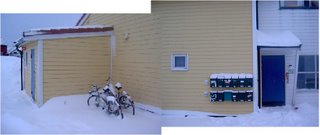

A 250 ton monster
"Candidate (20e) wins when DEP is dominated by the others", "LIN ranks higher than MAX, thus the violations that do occur are not fatal" and "This discussion also serves to introduce evidence of a conspiracy between substitution and deletion"... Fragments from a yellow mystery? A sumo match commentary? An article about sexual abuse in the military? Hardly. Just excerpts from a couple of articles i'm reading for my phonology class. I'm expected to produce their abstracts and present them in class.
Apparently, phonologists love to personify their study subjects. Yet, considering that what phonology studies is how different sound features interact in human speech, it is disorienting to think authors would go to the bother of giving human traits to processes that are so inmaterial. Plus, why complicate things with metaphores? Isn't this stuff unintelligible enough already? Granted, drawing comparisons can be helpful sometimes, but in this case i just find them distracting.
"Candidate (20e) ended up leading the mission because of his interpersonal skills. He proved to be the only one able to get the other finalists to act in a coordinated manner, and since such coordination was the only way in which the cruel DEP could be defeated, everybody accepted his dominance. Massing 250 tons and towering over the city's skyscrapers, DEP was created to test that those citizens aspiring to replace the mayor would really risk their life for the welfare of their hometown."
That's more like it! But i'm sure this is not the kind of abstract they are after.
Apparently, phonologists love to personify their study subjects. Yet, considering that what phonology studies is how different sound features interact in human speech, it is disorienting to think authors would go to the bother of giving human traits to processes that are so inmaterial. Plus, why complicate things with metaphores? Isn't this stuff unintelligible enough already? Granted, drawing comparisons can be helpful sometimes, but in this case i just find them distracting.
"Candidate (20e) ended up leading the mission because of his interpersonal skills. He proved to be the only one able to get the other finalists to act in a coordinated manner, and since such coordination was the only way in which the cruel DEP could be defeated, everybody accepted his dominance. Massing 250 tons and towering over the city's skyscrapers, DEP was created to test that those citizens aspiring to replace the mayor would really risk their life for the welfare of their hometown."
That's more like it! But i'm sure this is not the kind of abstract they are after.
Thursday, October 26, 2006
Reflections
I enjoy looking at reflections. I agree with Borges: mirrors make you believe they are gateways to other universes. Windowpanes even more so, as you can see both what lies behind them and, superimposed on that, another place, ghostly, both there and not there. Mannequins with paralytic smiles modelling the season's latest, and at the same time buses and cars and people scurrying in all directions; the warm bustle of a university entrance hall and likewise an open, gray sky, leaves falling from tree branches and a dot in the distance that turns out to be a helicopter.
And then, if you focus, you meet your own eyes, your choices. Perfect imitators, those others, but each different.
Two realities coincide on the reflective surface, and for a few seconds or minutes they are both cordinated. But as soon as we move out of the frame our paths diverge, and while i bend down to tie my shoelace, he's done something totally unexpected, like bumped into a rhinoceros or adjusted his breathing pack in order to take a walk on the surface of his planet.
Maybe he gives me the finger, too, and i just can't see him doing it.
And then, if you focus, you meet your own eyes, your choices. Perfect imitators, those others, but each different.
Two realities coincide on the reflective surface, and for a few seconds or minutes they are both cordinated. But as soon as we move out of the frame our paths diverge, and while i bend down to tie my shoelace, he's done something totally unexpected, like bumped into a rhinoceros or adjusted his breathing pack in order to take a walk on the surface of his planet.
Maybe he gives me the finger, too, and i just can't see him doing it.
Mining
Meridian Gold is a multinational company with base in Canada, interested in exploiting an open air, gold and silver mine in Esquel, Argentina. It promised employment for 300 workers, but a group of neighbors started a campaign to bar operations. Since the separation of gold and silver from their ores requires the use of cyanide and arsenic respectively, people were worried about the possible contamination of rivers and ground water. They formed a neighbor assembly, organized peaceful protests and finally convinced the communal authorities to call for a plebiscite. The voting options: yes to the mine, no to the mine.
In turn, Meridian Gold organized "information events" designed to convince the constituency of the supposed safety of their intended enterprise. Barbecue, training shoes and other gifts were offered to those attending, a strategy that has been common in the political past ("past"?) of Argentina.
In any case, people ate the barbecue, accepted the shoes and other gifts and in march 2003 went to vote. 75% of the municipality's voters showed up, a record high. Of all ballots, 81% went to "No to the mine". This should have been the end of the matter.
"A people who do not sell themselves cannot be bought", said an inhabitant of Esquel on TV. But there is always a but, and money has its weight, particularly when there is a lot of it to go around among politicians and corrupt union workers. You may not want to be bought, but you might still be sold. Of course, again, one may wonder why ethically enlightened nations allow unethical companies based on their soil to conduct such unethical business with such unethical partners.
In any case, and since we are talking about corruption, consider the following facts:
1) Meridian Gold's work plan would mean an extraction of gold from the Esquel mine equivalent to 2.5 billion dollars in 10 years. Silver production is not included in these calculations.
2) Law 25.161 states that the argentinean nation may only receive a maximal 3% in commissions from any company exploiting mineral deposits within its borders. These commissions will be calculated on the value of the mineral as it is extracted from the mine, which is always much lower than after refinement. Incidentally, the same laws say that the argentinean state can exploit mineral deposits only through private companies (it still would have to prove to me that it would do a cleaner job, but at least it'd have more incentives to do so. In any case, this fact does give an idea of the thinking behind such laws. Let's encourage investment by all means, right?).
3) In round numbers, and assuming that the value of the gold, as extracted from the mine, were equivalent 2 billion dollars in 10 years, the part corresponding to the state would be some 60 million dollars. However, since the 3% figure is only a maximum set by national law, Chubut province (where Esquel is) has legislated that 2% should be enough (Provincial Law 004018). We are down to 40 million dollars.
4) Another couple of interesting national laws that help illustrate the situation are 23.018 & 24.490. In order to favor exports from Patagonia, the state will reimburse 5% of the value of such exports to the exporters. This would mean that Meridian Gold would be receiving 125 million additional dollars.
THUS, ARGENTINA WOULD BE PAYING 85 MILLION DOLLARS TO MERIDIAN GOLD SO THAT THEY CAN TAKE 2.5 BILLION DOLLARS AWAY!
And this is without taking into account other "incentives", such as a 100% deduction of prospecting expenses (law 24.196), the promise that taxing will remain constant for 30 years (same law), and a long etc.
Going back to the situation in Esquel, here are the developments after the plebiscite.
The company promised to respect the decision, but started lobbying for exploitation again shortly after. Public resistance continued and, finally, on july 14th of this year the province proclaimed a moratorium on mining in the Esquel area... for a period of three years (hoping that it will be long enough for people to forget?). Then, this month, the argentinean subsidiary of Meridian Gold took six citizens of Esquel to the federal court, accused of making public a recording of a 2003 meeting of CEOs and consultants of the firm. In it one of the executives is clearly heard saying: "the people of Esquel must not know that we intend to bend their will".
You can find more information about all of this on:
www.noalamina.org (Spanish. This is the site created by the Esquel neighbors.)
http://www.anred.org/article.php3?id_article=1786 (Spanish)
http://www.nodirtygold.org/esquel_argentina.cfm (English, but a bit dated: 2003)
If you want to hear the company's side of the story, here is their website:
http://www.meridiangold.com
You can phone them at their headquarters and ask them (phone is the only choice, as the only e-mail they publish on their website is for you to contact them if you want employment):
Meridian Gold Inc.
9670 Gateway Drive, Suite 200
Reno, Nevada 89521
Telephone: +1 775 850 3777
Also, to learn more about mining investment policies in Argentina, you can go to
http://www.inversiones.gov.ar/documentos/mineria.pdf
You can check there that i'm not exaggerating. Again, unfortunately, this is only for Spanish speakers.
Finally, here are some people you can call:
Matilde Lenzano: +54 2945 453713
Lino Pizzolon: +54 2945 453679
Silvia Pérez: +54 2945 454811
Chuni Botto: +54 2945 452521
These are some of the Esquel inhabitants in the neighbor assembly. The one i talked to is Silvia Pérez.
In turn, Meridian Gold organized "information events" designed to convince the constituency of the supposed safety of their intended enterprise. Barbecue, training shoes and other gifts were offered to those attending, a strategy that has been common in the political past ("past"?) of Argentina.
In any case, people ate the barbecue, accepted the shoes and other gifts and in march 2003 went to vote. 75% of the municipality's voters showed up, a record high. Of all ballots, 81% went to "No to the mine". This should have been the end of the matter.
"A people who do not sell themselves cannot be bought", said an inhabitant of Esquel on TV. But there is always a but, and money has its weight, particularly when there is a lot of it to go around among politicians and corrupt union workers. You may not want to be bought, but you might still be sold. Of course, again, one may wonder why ethically enlightened nations allow unethical companies based on their soil to conduct such unethical business with such unethical partners.
In any case, and since we are talking about corruption, consider the following facts:
1) Meridian Gold's work plan would mean an extraction of gold from the Esquel mine equivalent to 2.5 billion dollars in 10 years. Silver production is not included in these calculations.
2) Law 25.161 states that the argentinean nation may only receive a maximal 3% in commissions from any company exploiting mineral deposits within its borders. These commissions will be calculated on the value of the mineral as it is extracted from the mine, which is always much lower than after refinement. Incidentally, the same laws say that the argentinean state can exploit mineral deposits only through private companies (it still would have to prove to me that it would do a cleaner job, but at least it'd have more incentives to do so. In any case, this fact does give an idea of the thinking behind such laws. Let's encourage investment by all means, right?).
3) In round numbers, and assuming that the value of the gold, as extracted from the mine, were equivalent 2 billion dollars in 10 years, the part corresponding to the state would be some 60 million dollars. However, since the 3% figure is only a maximum set by national law, Chubut province (where Esquel is) has legislated that 2% should be enough (Provincial Law 004018). We are down to 40 million dollars.
4) Another couple of interesting national laws that help illustrate the situation are 23.018 & 24.490. In order to favor exports from Patagonia, the state will reimburse 5% of the value of such exports to the exporters. This would mean that Meridian Gold would be receiving 125 million additional dollars.
THUS, ARGENTINA WOULD BE PAYING 85 MILLION DOLLARS TO MERIDIAN GOLD SO THAT THEY CAN TAKE 2.5 BILLION DOLLARS AWAY!
And this is without taking into account other "incentives", such as a 100% deduction of prospecting expenses (law 24.196), the promise that taxing will remain constant for 30 years (same law), and a long etc.
Going back to the situation in Esquel, here are the developments after the plebiscite.
The company promised to respect the decision, but started lobbying for exploitation again shortly after. Public resistance continued and, finally, on july 14th of this year the province proclaimed a moratorium on mining in the Esquel area... for a period of three years (hoping that it will be long enough for people to forget?). Then, this month, the argentinean subsidiary of Meridian Gold took six citizens of Esquel to the federal court, accused of making public a recording of a 2003 meeting of CEOs and consultants of the firm. In it one of the executives is clearly heard saying: "the people of Esquel must not know that we intend to bend their will".
You can find more information about all of this on:
www.noalamina.org (Spanish. This is the site created by the Esquel neighbors.)
http://www.anred.org/article.php3?id_article=1786 (Spanish)
http://www.nodirtygold.org/esquel_argentina.cfm (English, but a bit dated: 2003)
If you want to hear the company's side of the story, here is their website:
http://www.meridiangold.com
You can phone them at their headquarters and ask them (phone is the only choice, as the only e-mail they publish on their website is for you to contact them if you want employment):
Meridian Gold Inc.
9670 Gateway Drive, Suite 200
Reno, Nevada 89521
Telephone: +1 775 850 3777
Also, to learn more about mining investment policies in Argentina, you can go to
http://www.inversiones.gov.ar/documentos/mineria.pdf
You can check there that i'm not exaggerating. Again, unfortunately, this is only for Spanish speakers.
Finally, here are some people you can call:
Matilde Lenzano: +54 2945 453713
Lino Pizzolon: +54 2945 453679
Silvia Pérez: +54 2945 454811
Chuni Botto: +54 2945 452521
These are some of the Esquel inhabitants in the neighbor assembly. The one i talked to is Silvia Pérez.
Wednesday, October 25, 2006
Huh?
"Although we cannot find that a fundamental right to same-sex marriage exists in this state, the unequal dispensation of rights and benefits to committed same-sex partners can no longer be tolerated under our state Constitution," Justice Barry T. Albin from New Jersey argued, in passing a state court ruling that does... exactly what?
Does he mean find as in when you're looking for something, or find as in "pass judgement"? If the first, duh! Gay marriage is nowhere to be found. At least not in that constitution he refers to towards the end, which is where i supposed he would have looked. If the second, why can he not pass judgement on it being a fundamental right? "The unequal dispensation of rights and benefits to committed same-sex partners can no longer be tolerated", but marriage is one of those rights, isn't it?
Maybe he meant that the constitution must be interpreted to say that denying such rights is inconstitutional, even though it does not expressly allow homosexual marriages. If so, it needs to be changed to include them.
OK, 6-7 for clarity. As for intentions, let's give him the benefit of the doubt.
Does he mean find as in when you're looking for something, or find as in "pass judgement"? If the first, duh! Gay marriage is nowhere to be found. At least not in that constitution he refers to towards the end, which is where i supposed he would have looked. If the second, why can he not pass judgement on it being a fundamental right? "The unequal dispensation of rights and benefits to committed same-sex partners can no longer be tolerated", but marriage is one of those rights, isn't it?
Maybe he meant that the constitution must be interpreted to say that denying such rights is inconstitutional, even though it does not expressly allow homosexual marriages. If so, it needs to be changed to include them.
OK, 6-7 for clarity. As for intentions, let's give him the benefit of the doubt.
Subscribe to:
Posts (Atom)
