Wednesday, October 25, 2006

Beauty marks and the such


Yesterday i watched "Some like it hot", with Marilyn Monroe. Neat movie, but minds work strangely, and since mine is very weird --as it's been amply shown here-- it started mulling on the beauty mark Marilyn had above her lip. From there it locked on to the words "beauty mark" themselves. Why not simply "mole"? What is it about a mole that creates beauty? Placement? Maybe. I have a mole on my neck, but haven't been asked to star in any movies, so it probably doesn't qualify... Shape? My mole is lumpy and not totally round, with a couple of hairs coming out of it. They do say beauty is in the eye of the beholder though, so if you're interested, remind me to show it to you next time we meet.

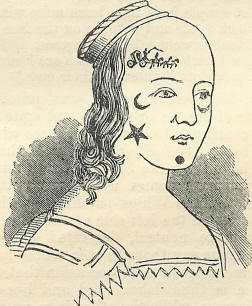
Anyway, back to real beauty marks. I've read somewhere that two or three centuries ago they were the rage in France, particularly among the high classes. Except they weren't real beauty marks, but fake ones. Both men and women would glue bits of black taffeta to their faces in the hope of heightening their looks. But isn't a mole, by definition, an imperfection on the smooth surface that the skin is supposed to be? How could fake moles make them more beautiful? What the heck were they thinking?

The french aristocracy of the time has such a bad reputation already (i mean, their heads ended up being chopped off, so they must have been quite nasty) that i'm sure nobody would mind my interpretation: they thought themselves so perfect already, that they wanted to pretend they had imperfections, pretend being the keyword. "Hey, look" they were saying with their bits of black taffeta. "I'm so perfect that even my imperfections are fake."

But, as it turns out, i'm wrong. I got on the net and the story is quite different. Before i go on, and in case you're wondering, i do have much better things to do (i.e. homework) but it's boring.

In any case, the fashion of sticking bits of cloth to the face originated in England in the XVIth century, not in France. In that country and at that time, people would use not only black taffeta, but all kinds of fabric, and even leather, all dyed different colors. They'd plaster themselves with several pieces at a time, cut out in various shapes. It seems that smallpox was rampant, and these patches were supposed to cover the not-so-beautiful marks the sickness left behind. That it later became a fashion even for the unscarred is not so surprising, given the monkey-see-monkey-do monkeys that we are.

Me, if i'd had to choose, i would have worn the carriage and horses. Rather that than making a hole in my nose and hooking a bit of metal through it.

Tuesday, October 24, 2006

www.one.org

Have you been to this website, yet?

www.one.org

Great campaign. Sign up!

Sunday, October 22, 2006

More

27 hours of continuous snowfall, so far. We're up to 50 cm already. This means no more rain till at least april, i hope.

Friday, October 20, 2006

Faces

Thinking of faces. What are they? When you're a child you draw them as an oval; then you attach eyes, a nose, a mouth. Ears, too, if you're really into details. That's why Mr. Potato head is such a popular toy, i suppose. We're obsessed with faces. We love to attach things to them, to guess their story. If you're shy you avert your eyes, as if looking away from a face made your own disappear.

There is no other part of the body we decorate more: rouge, lipstick, earrings, shaving, waxing, filing away of cheekbones, whitening tooth paste, facial soap, piercings, base, depilation, nose-hair trimming, silicones for the lips, rimmel, glittery dental caps, eye-shadow, mint drops, artificial eyelashes, haircuts, lip balm, wigs, nose jobs, facial scrubs, liftings, anti-wrinkle cream...

Yet we don't consciously think of faces all that much. I guess that as we grow up we become used to them. We learn to see them as a whole. Only sometimes you pull back, and you wonder why a nose is where it is. You're taken aback, your analytical mind hits static.

The mouth, smooth and red, tiny vertical lines on lips, and where the lips meet, an angle, as if a hinge. The mouth is not round. Sometimes there is that fuzz that grows above the upper lip, those creases that converge on the toothy gap, fractured as if river canyons that run to an inland sea. The tongue, why wet? The nose, no such thing as a cute one: all grotesque, mountains and caves on a smooth plain. The ears, atrophied things that do not move, misplaced, the wings on Mercury's sandals. The eyes frustrating, not windows of the soul but a reminder that you can never get past them, you can't ever really get in. The forehead that goes on and on, a wasteland, twin to the cheeks.

A skewed view

Legs: the twin appendages that grow out of the ground till they connect with the hips. Regularly and alternatively uprooted, they may allow the hypothetic wearer a motion of some kind.

Coffee: the perfect drink for the insomniac. It unnaturally extends wakefulness, so that when its effects wear off the organism is truly exhausted and sleep can be easily achieved.

Canned guacamole dip: a paste made of soya oil and maltodextrin designed to taste as nearly unlike avocados and tomatoes as scientifically possible.

the moon: generic name for the luminiscent circles or sickle shapes that are occasionally cut out of the sky when it turns dark.

boredom: the irresistible desire to do nothing.

Thursday, October 19, 2006

The prediction

I don't remember the exact circumstances, but when i got to Guangzhou and attempted to buy the train ticket to Hong Kong, they would not take my money. Somehow it wasn't possible for me to get any until i got to the Hong Kong side, but i couldn't get there without it... So, i stood in the platform, smelly clothes and huge backpack on my shoulder, and explained the situation to some passersby: do you speak english? could you please pay for my ticket, and i will give you back the money as soon as we arrive?

Finally this guy stopped, looked me up and down, asked me a few questions about myself, and agreed to help me.

We started chatting on the train. He was cantonese, 40-something, i guessed. He asked me what i was doing in China, what my occupation was, where i lived... Then it was my turn to ask. He said he worked for some kind of organisation, Maharishi something-or-other. As he talked i realized Maharishi was a new age institution or group: he talked about energies, life lines, predestination... I don't exactly remember, either. This was 15 years ago, after all.

He was helping me, and he didn't seem to be proselitizing, so we had an animated conversation. However, when i tried to ask somewhat critical questions about some of the stuff he said, he didn't seem to like it very much; i figured he'd be happier if i just let him talk, so i only asked enough to keep him going. At some point (i don't know how we got there) he was reading my palm, and that part i remember very well.

He said i am the eldest of three brothers --i am--, he said i was born in march --i was-- and he said i would die in a catastrophe at age 34 --i stared at him.

"Really?" i asked after a couple of seconds.

"Well, one can never be completely sure, but as far as i can tell, yes. There will be a big disaster, and you'll be one of the victims" he said.

"And is there any way i can avoid it?"

"No. [Destiny something or other]"

I was remembering this stuff yesterday afternoon, as it was the 34th birthday of a guy at the uni today. Maybe i should have waited to write about it till i turned 35 myself, but what if that catastrophe gets in the way?

Not that i'm very worried, really. He himself said i shouldn't, and that i'd meet the woman who'd be my wife in the following weeks.

Some yummy crumbles of that pie

(by Don McLean)

A long, long time ago...
I can still remember
How that music used to make me smile.
And i knew if i had my chance
That i could make those people dance
And maybe they'd be happy for a while.

Did you write the book of love,
And do you have faith in God above,
If the bible tells you so?
Now, do you believe in rock 'n roll?
Can music save your mortal soul?
And can you teach me how to dance
Real slow?
Well, i know you're in love with him
'Cause I saw you dancing in the gym.
You both kicked off your shoes.
Man, I dig those rhythm 'n' blues!
I was a lonely teenage broncin' buck
With a pink carnation and a pickup truck
But i knew that i was out of luck
The day the music died.

A room with a view

Check out this link out:

http://video.google.com/videoplay?docid=3491667610082638914&pr=goog-sl

It is a video that Thomas B. made by splicing together pictures taken from a window in Andresen building. He apparently took them during the same time of day throughout a few weeks in the fall of 2004: this beauty is the result. I came across it in a link on the college's homepage. Hadn't visited in a while, was nice to be back.

Thanks, Thomas.

Tuesday, October 17, 2006

Aural clues

I'm in my office. I close my eyes and i can know:

how much it's snowed by the almost mute quality of the sounds made by cars in the street outside; that Kwame hasn't peed in a long time because the splashing in the toilet goes on forever; that the air i'm breathing has come to me through tubes, by the whispering of the ventilation system; that my chewing of the gum in my mouth pushes aside the saliva that covers it over and over, by the squelching sounds produced every time i sink my teeth in it; that there is some kind of spring underneath the keys on the computer's keyboard, because i hear them twang faintly when i release them.

Monday, October 16, 2006

Madre de lejos

Que estoy sola me dice mi madre
Sola de mañana y de tarde sola
Y de noche. Que estudio italiano
Que enseño pintura y lavo los platos
Pero las alumnas son viejas cornejas
Y los platos son platos y no les hablo
aún.
Que quiero salir, manejar otra vez
Que desde aquel accidente no lo volví a hacer
Quiero afuera y quiero gente.

Y yo que de lejos la veo
Desde este país para acá del teléfono
Siento que su vida se me achica dentro
La extraño y extraño los años que tuvo y no tuvo
Por pobreza de niña,
Por matrimonio joven,
Por cinco hijos ya a los veintiséis
Por cuidar a su madre
Por quiste en matriz
Por educación de niña que le dice
Que debe sacrificar todas sus perdices
Por sus hijos, por su casa y por todos
Que vos venís última, después
De los otros.

Que salga le digo que valga
Que tenga y que haga
Que merece que necesita
Que debe y que no debe
Y ya estamos otra vez
En una novela de la tele.

Y ella que si, que tanto,
Que lo hará, me dice
Que quiere
Que ya habló con mi padre
Que el año que viene.

La vida de mi madre
se me achica dentro.

Sunday, October 15, 2006

Lost opportunity

I think i may have just missed a job opportunity... It happened like this:

I'm checking my e-mail just now and there's a message from Per, one of the professors at the linguistics department. He says he needs an interpreter who can do italian-english-italian simultaneous translations for all day tomorrow. There's this cook who's arriving from down there, and they need to communicate with him. Someone told Per i speak italian, so if i get the msg today could i please give him a call at such and such number, no matter the hour? I'd be paid, of course...

It's 11:00 pm, sunday night... Am excited about the possibility, but the message was sent in the morning. What if the guy's in bed already? Anyways, i decide to call. He sounds glad i did, but tells me they've already found someone else. Nevertheless, it's good to have my number, he says, in case the other person doesn't show up. He asks about my italian and i honestly admit i'm no native speaker, but that i know i can manage. "Do you know much about cooking, then?", he says.

I don't intend to, but burst out laughing. I mean, in the past two months i haven't used the kitchen for anything other than boiling water, defrosting pizza, and cooking rømme graut (once)! With this thought in my mind, i giggle stupidly for a few seconds longer; silence on the other side. I finally catch my breath: "Well, i can identify ingredients. Don't ask me to put them together, though...".

"Hmmmm, good. Keep your phone with you tomorrow, and we'll give you a call you if we need you, ok? Thanks for answering to my message."

"Thank you for the chance", i say, and we hang up.

Somehow i don't think they'll call me. Seemed like in order to translate cooking, you need to be a cook yourself. Either that, or to sound a little less hysterical on the phone.

Allegory

Ian and North Kathy want to start smoking. I want them not to. I smoke myself, so i really have no authority to say anything to them, but i'm big and burly and i could kick the shit outta them. That's my leverage. If anybody asks, i'll say that i'm older, more mature, and that i know how to smoke responsibly, whereas they don't. They could ruin their lungs and those of everybody around them.

Friday, October 13, 2006

Physical bits

We leave behind physical bits of ourselves throughout our lives -- no need to go into details here, but when you think about it, all of it put together probably weighs more than the body does at death. Yet it is that body that we focus on: we either embalm it and/or entomb it in little funereal cities within cities, or we spend a lot of caloric energy to turn it into ashes. Why not lay it underneath a tree, to feed it quickly to life, or recycle it in some other fashion? Fifty or one hundred kilos is a lot of organic matter.

We don't like to think of death. We think it is obscene.

I suppose it is, to some extent, but like so much else, it is also its context.

PBL weeks

I miss them.

Tuesday, October 10, 2006

Zero

Have you seen the add campaign for Coke Zero? Big bold letters that say something like "REAL TASTE, ZERO SUGAR" and underneath that, different captions: "Then why not action movies with zero romance?" or "Why not a girlfriend with zero headaches?" or (my personal favourite) "Why not two girlfriends with zero jealousy?".

G-E-N-I-U-S! I mean, the way this kind of publicity focuses on us guys! Consider the reasoning behind it: girls are already so freaked about their physical image that they'll always buy low sugar sodas anyway, so you don't have to convince them of anything. They'll buy this Zero stuff even if the add campaign were purposefully trying to alienate them -- which it doesn't really, right? After all, everybody knows that guys hate all that mushy romance crap, and that we'd go out with two or more girls at once if we could. Boys will be boys, ikke sant?

So this campaign is really positive, as it puts the dots on the i's and lets us all know where we stand. Guys like me will feel thankful for the reassurance and sense of belonging provided: that i can't get my mind off my girlfriend's boobies while she's concentrating on the latest chick-flick, or that i want to hump her and her best friend too (possibly together), does not make me a freak... That's what we men do! ("Besides, man, i wouldn't be cheating. I do love them both!"). As a token of our gratitude, boys and men everywhere will buy Coke Zero. Girls and women will chug Zero down, too, while dreaming of becoming slim enough to have the possibility of being two-timed jealouslessly.

Real doo-doo, Zero sense.

Friday, October 06, 2006

The attack of latitude on convencional wisdom

The sun rises in the --south-- (if ever) and sets in the --south-- (if ever). At noon the sun is never directly above your head, but most probably at eye-height and blinding you while you're waiting for the bus.

Compuesto y sin novia

de Miguel de Molina

¡Ay! Tuve una novia modista
y un mal amigo me la quitó,
y tuvieron tres churumbeles
con la cabeza como un farol
y el guardia de los padrones
dijo "¡qué espanto! ¡qué atrocidá!
Cabeza de esta familia,
¡qué muchas de ellas!
¿quién lo será?

Con la modista
no me he casao
y del quebraero de tres cabezas
¡yo me he librao!

"¿Y por qué no te casas niño?"
dicen por los callejones.
Yo estoy compuesto y sin novia,
porque tengo mis razones...
Esposa, suegra y cuñao,
diez niños, y uno de cría
que la feria, que la gripe,
que tu mare, que la mía...
Son muchas complicaciones;
Soltero pa' toa la vía...

Ahí me encuentro yo al matrimonio
tos los domingos en el café,
con las caras 'e avinagraos
porque se aburren como un cipré.
Los niños rompen las tazas
y con la fuerza de un albañí,
le meten a pare y mare
la cucharilla por la narí.

Con la modista
no me he casao
y del tormento de la cuchara
¡yo me he salvao!

"¿Y por qué no te casas niño?"
dicen por los callejones.
Yo estoy compuesto y sin novia,
porque tengo mis razones...
Esposa, suegra y cuñao,
diez niños, y uno de cría
que la feria, que la gripe,
que tu mamá, que la mía...
Son muchas complicaciones, hombre.
¡Que a mí no me trinca nadie!
¿De dónde voy a atracar yo?

¡Que no me caso, vamos!
¿Les parece poco la muestra?

La casa de mis amigos
es un pellizco de habitación
y por eso duermen de noche
las tres cabezas en el balcón.
La casa se bambolea
con aquel peso fenomenal
y pitan las chimeneas
como los barcos por altamar.

Con la modista
no me he casao
y del terremoto de San Francisco
¡yo me he salvao!

"¿Y por qué no te casas niño?"
dicen por los callejones.
Yo estoy compuesto y sin novia,
porque tengo mis razones...
Esposa, suegra y cuñao,
diez niños, y uno de cría
que la feria, que la gripe,
que tu mamá, que la mía...
¡Qué monada! ¿Verdad?

¡Soltero pa' toa la vida!

Thursday, October 05, 2006

Senryuu

泥棒を doroboo o
捕えてみれば toraete mireba
我が子なり wagako nari
------------------------------(Senryuu Karai)

My dad told me today about a situation in a school in my hometown. Apparently students, while celebrating the beginning of the summer vacations (two months in advance) vandalized school property and caused damages for several thousand dollars. The administration reacted by distributing sanctions, and parents have taken the school to court.

Catching him
You see the robber
Is your own son.

Well, i guess you should let him get on with his business, then.

Determiner phrases

This is really cool. We talked about it in the syntax class last week.

Imagine the phrase "The five dead flies". Since this is english, the word order is "determiner >> numeral >> adjective >> noun". No other sequence is possible. "Flies five dead the", for instance, makes no sense at all. You might have something like "Five of these dead flies", but then the meaning is different, and you have that little "of" there, which you didn't have before.

In a language such as spanish, however, the order is different. You have "determiner >> numeral >> noun >> adjective", that is to say, "Estas cinco moscas muertas". "Determiner >> numeral >> adjective >> noun" is also permissible, but is not the 'original' form. It doesn't always sound well. If you want to test this, ask a native speaker to choose between "Estas cinco moscas muertas" and "Estas cinco muertas moscas". You'll see.

Other languages, such as yoruba, have as their order the exact opposite of english: "noun >> adjective >> numeral >> determiner". They say something like "Flies dead five these".

Now, if you tackle the problem from a mathematical point of view, there are 24 possible orders in which you might arrange these 4 elements (4 x 3 x 2 x 1 = 24). Yet --and this is the surprising bit-- among the more than 7000 languages spoken now or in the past by human beings, only 14 of these 24 orders are attested.

Furthermore, there's this guy called Guglielmo Cinque who managed to come up with a system by which, departing from one of these orders, you can derive the other valid 13, but not the 10 'wrong' ones. This method is consistent with the rest of syntactic analysis, requires that one starts always from the same, unique 'underlying' order and, what's more, nobody else has been able to come up with any simpler or clearer system that does the same.

This seems to be telling us that only a certain number of operations are possible in the brain with regard to languages. It suggests that language is indeed something that we can learn, but that it can only exist as defined by certain rules and parameters already present within the human brain.

Neat huh?

Tuesday, October 03, 2006

Been reading all morning...

...and i don't understand even half of it. I hope we'll get some good explanations in class today, or i'm fucked.

Monday, October 02, 2006

Lazy... I'm lazy for fee-ling so lazy-y-y-y...

Am supposed to read a pile of articles for tomorrow's classes, but can't get myself to do it. I think i'll just take a shower now, set my alarm clock for 4:00 am, make myself some tea, get in bed and watch a movie.

Surrounded

Diamond Valnøtter, Konica, Leitz, Tine, Sony, Fujitsu Siemens, Bic, Pentel, Weetabix, Cachamai, Nora, Coop, Ricola, Santa Cristina, Dan Sukker, Osram, Lerum, Gillette, Lancaster, Rocío, Nivea, The Body Shop, Vapo, Adidas, Colgate, Idun, Mr. Lee, Royal, Hasat, Seltin, Patak's, Poppeli, Clipper, Twinings, Creative, TDK, Binaca, Johnson & Johnson, Define, Paco, ReaLime, Bialcol, Imsdal, Quechua, Scholl, Penol, Pilot, Lipa Mill, Intex, TinyDrive, Weetos, Toro, Dovre, Aceca Inc., McIlhenny Co., Nitedals, Rollerblade, Milano Uomo, Tee Jays, Tommy Hilfiger, Vitaplex, Ultimo, Fabrizzi, ICA, El Corte Inglés, Christian Dior, Marco Polo, WBÄ, Mares, Jelly Belly, Pasofirme, Thinsulate, Chiruca, Linyi, IKEA, Canon, Philips, Garrity, Duracell, Exide, Citrucel, Spar, Berocca, Glade, First Price, Albus, Bayer, Boots, Luis Trombetta, Inti, Tylenol, Collett, Iodosan, Nico-Hepatocyn, Paramed, Digestan, Roemmers, Weiga, Tarragó, Kleenex, Maxell, Calvin Klein, Ocean, Val Venosta, Santa Maria AB, Coca Cola, Artsana, El Reloj, KAI, Brossa, Wrigley's, ACO HUD AB, Kangaro, Nitedals, Stanley, Tartan, Benchtop, Mitsubishi, Plus, SHF, Post-it, Festo, Masel, Staedtler, La Iride, Tomado, You, Punto de Origen, B & C, Sportyear, Marshall Field's, Sveico, Bantex, Ralph Lauren, Janus, Mack.

All in here with me, within a 2 meter radius. Plus, those brands that sell components to the brands that have sold me the products i've bought, plus those whose brandname i can't see because they didn't put it in (i.e., the company that built the walls around me), plus books, each with their editorial house (they must count as brands), plus other brands i must have missed because no way i'm gonna spend my evening going through all my things just to check out where they're stamped.

The only non-brand things i can see around me are: a hand-made teabox that Yanina's mom gave me, my mate cup, some lychen-covered rocks i put on my windowsill after a mountain hike, my body, a moth on the ceiling, and the darkness outside the aforementioned window. Oh, and some dust on the floor, which i haven't sweeped in a while.

Of these i must probably discard the teabox and the mate cup, because some branded tools were probably employed in their crafting. My body has had so much contact with brands it probably wouldn't be where it is now if it weren't for its relationship with them (i mean, birth in a hospital, a couple of surgical interventions, glasses, reading Penguin Books, planes, blah blah). Some of the dust is also dubious in this way, so only the rocks, the darkness and the lychen are left.

Must get myself some higher-order plants to accompany the lychen, so that i can be more in touch with the un-branded world. I'll go to the forest behind the bolig and dig out a pine sapling -- with my bare fingers, of course. Then i'll chew out the center of a log and plant it there.

Oops! Forgot: can't use my fingers nor my teeth. Dang!

Sunday, October 01, 2006

Beginning of a novel?

In the end, space exploration payed off: all the research that went into recycling water and oxygen had to be used on Earth. When the surface was no longer livable, we retired to the interior and learned to recycle our breath and our sweat.

Saturday, September 30, 2006

Walt Whitman's "My Pen" (1900)

WHAT think you I take my pen in hand to record?
The battle-ship, perfect-model’d, majestic, that I saw pass the offing to-day under full sail?
The splendors of the past day? Or the splendor of the night that envelopes me?
Or the vaunted glory and growth of the great city spread around me? —No;
But merely of two simple men I saw to-day, on the pier, in the midst of the crowd, parting the parting of dear friends;
The one to remain hung on the other’s neck, and passionately kiss’d him,
While the one to depart, tightly prest the one to remain in his arms.

Friday, September 29, 2006

Tanka

By Tawara Machi (1987):

"Kono aji ga
iine" to kimi ga
ittakara
shichigatsu muika wa
sarada kinenbi


("This tastes
great" you
said, and so
the sixth of july,
our salad anniversary.)

- - - - - - - - - - - - - - - - - - - -

By Yosano Akiko (1901):

Kurokami no
chisuji no kami no
midaregami
katsu omoimidare
Omoimidaruru


(Of black hair
a thousand strands
all tangled, tangled,
and tangled too
my memories of us.)

Evolution

Today i attended a seminary on phonology, and the speakers were talking about codas, onset, nuclei and a bunch of other stuff that we haven't even begun to look at in our classes yet... So my mind wandered off again.

Why do our skins have so little hair on them, compared to other animals?

My first thought was that this was indicative of our having evolved it in a hot, dry climate such as that in the African savvanah. After all, here in the Arctic you see people wearing a lot of clothes, and if we had pelts growing on us we could save some money and buy a few more beers instead of so many sweaters and jackets and scarfs. Also, if we'd spent an evolutionarily long time in a hot and wet place, we might have evolved something similar to oilcloth (preferably yellow), but that's not the case, either.

Then it occurred to me that most animals in the savannah do have pelts. Lions and jiraffes do, so how to account for this discrepancy? There are a few animals in that general area that have hairless skins, namely naked mole rats and hippos, so perhaps we evolved our hairless skin underground, or while floating our lives away on lakes and swamps? The buckteeth on some people do seem big enough to be a remainder of some earth-churning existence in tunnels... But if so, where are the palmate, thick claws supposed to aid in the digging? As for the lake possibility, i haven't discarded it yet. Maybe that's why i miss so much having a tub in my bathroom.

Later i realized i might have reversed cause and effect. Maybe it's not that we wear clothes because we don't have pelts, but the opposite is true: that is, we lost our pelts because we started to wear clothes. Someone should do the mathematics, but probably it's more expensive for a body to grow a lot of hair than to pay for a tailor.

Seriously though... What this implies is that our loss of hair has nothing to do with climate, but with the fact that wherever we may live, we possess the ability to cover ourselves and function in most weather conditions found on this planet. So maybe our hairlessness is related to our big brains, too (i know, old story).

If this were the case, though, why do we still grow so much hair on our heads? After all, at the gap we may buy not only gloves, but also hats. Perhaps the hair is there as an extra protection, and evolutionary constraints spelled something like: "ok, let them decide how much cleavage they want to show, but their brains are too important to allow them to accidentally fry".

The logical question then is (yes, you guessed): why male pattern baldness, then? You see, if women also got consistently bald, then that might signal that evolution is learning to trust that we will consistently use hats. As they don't, we must consider other possibilities. Does male pattern baldness mean that the brain of men can be freely fried after a certain age? Or that from an evolutionary point of view it doesn't make any sense to give men's brains the additional protection after such an age? After all, once a guy reproduces, the woman can theoretically take care of the children herself. In some cases, say if he is violent, or stubborn, the woman might even do better without him, or with a less brainy version of him. So, if a guy doesn't have enough brains to protect his brains when he goes bald, then he may become stupid enough that the woman can manage him more easily.

If this is the case, then one should expect a correlation between baldness and stupidity. A fertile ground for someone's doctoral thesis, i'm sure.

Anyway, that's that. And if you think this is all nonsense, well, let me inform you that it can't possibly be, 'cause i still have all my hair.

Sabrina

1954. The young daughter of the chauffeur falls in love with the two very rich brothers who employ her father. Her redeeming features: she speaks excellent french, she's not after their money and she doesn't go for both of them at once (well, her affections overlap a little, but she makes up her mind in a couple of days).

After such agonising indecision Sabrina stays with the older brother, Linus, who is some 25 to 30 years older than her and a workaholic. Sabrina is played by Audrey Hepburn and Linus by Humphrey Bogart, who really was 25 to 30 years older than Hepburn, but an alcoholic instead of a workaholic.

To avoid the bad taste of showing such a mismatched pair kissing, their mouths keep a minimum distance of 5 cm throughout the film, which causes an effect of creepiness that was later to be perfectly imitated by Sophia Coppola in "Lost in translation".

In my opinion, Sabrina should have stuck with her original choice. David was only some 15 years older than her, and handsomer. Ok, so he was a bit of a womanizer, and in one scene we learn he'd kissed her on the mouth when she was 9 and he was teaching her to play tennis, but nobody is perfect...

Dear old Hollywood!!!

"Senate OKs detainee interrogation bill"

Shit, shit, shit, shit, SHIT!!

"In this new era of threats, where the stark and sober reality is that America must confront international terrorists committed to the destruction of our way of life, this bill is absolutely necessary," said Sen. Saxby Chambliss.

A bit of a paradox, don't you think? I mean, to protect a way of life by utterly changing it... A bit like building your own sandcastle and then stomping on it yourself so that the bullies on the beach can't.

Not that i'm saying that the American "way of life" is as illusory as a sandcastle, but it definitely has always had its cracks. That's where weed and bushes dig their roots into... and then end up making the walls crumble to pieces.

The particular crack i'm referring to are America's double standards, which more than a crack has become a canyon that plagues not only America, but... well, i was gonna say the whole developed world, but in fact, it plagues the whole of humanity. The reason why fingers are more easily pointed towards the 'first world' is because from the perspective of a 'third worlder', it seems that the developed nations have it in their hands to change things... Which in reality maybe they don't, any longer. Or maybe not so easily.

The double standards i'm talking about are those high and mighty humanitarian and environmental principles that let us point to that ignorant and miserable part of the world that is without them, those principles that draw clear limits within which all business must operate... while in the first world. However, if first world business goes to the third world (as it must, for the level of prosperity lived in the first world to be maintained), then it may do as it pleases. In fact, it MUST be able to do as it pleases, otherwise profits are not high enough.

Things have come to such a head that nowadays first world nations are indeed in deep... cra(cks)p. On the one hand, their citizens are becoming more and more educated, and they are demanding their governments to really live up to those beautiful principles. On the other hand, if a nation wants to pass laws demanding that multinational companies based on its soil conduct business only with those countries that demonstrate a certain level of internal justice and whatever the opposite of corruption is... well, then those companies will pick up their skirts and scamper away to that blessedly miserable, ignorant and --most importantly-- cheap part of the world: you can kiss goodbye those billions in tax revenues. I mean, businesses are doing it already, what with all those bloody chimney filters people want them to spend money on, and the high tithes exacted from them every year ("Democracy can be so feudal, it's disgraceful!" as my uncle Scrooge used to say). In any case, if you're in a public office and want yourself or your party to be re-elected, this is not a pretty picture. Ignore it for as long as you can, or try to keep people disinformed, or make deals with the companies under the table.

So you see: crumbling, crumbling. And terrorism is just that little extra, shitty, dirty bit of weight that gives us even less time to really fix the old place...

It all comes down to that old sigh: if we could really live up to our principles!

Wednesday, September 27, 2006

Matt

I met Matt in may. Seriously. Am not just making it up for the sake of the nice alliteration. I met him in May, but had known about him for a coupla months.

"Pillow talk"

Funny movie from 1959, Doris Day & Rock Hudson. They go to a bar and the pianist is playing a song:

"There's a Guy in this old town
I'm tellin' you a fact
He measures five feet up and down
And five feet front and back..."

"Oh!" says Doris Day's character to Rock Hudson's. "He's fat!"
Hudson assents sheepishly and, when she turns away, rolls his eyes at her ingenuity.

All this in a 50s movie!

Monday, September 25, 2006

Dead man's boots

There's a shoe rack outside my dorm room, here at the university. On its topmost shelf stood a pair of brown leather hiking boots, quite nice. I noticed them when i arrived, almost two months ago. Nobody had touched them in all this time. They didn't seem to belong to any of us three residents of the lower floor, and they didn't look like girl boots, either, so the top floor residents are probably out of the equation, too. Then yesterday, as i am coming out of the bathroom, the mystery is explained: the guy who lives at the end of the corridor has bought himself new shoes, and needs the space on the shelf for them.

-What should we do with these boots? - he asks.

-Well, i don't know. Who do they belong to?

-A guy who used to live here and died last fall. They've been there for almost a year.

-Oh. - i say. -Where did he exactly live?

-In your room, actually.

We repeat this conversation a couple of times. I want to make sure i've understood him. It might be my norwegian, but no. I understood right. The guy was a student of medicine. Died of heart problems.

-Do you want them, then? - he asks finally.

-Well... why not? I'm not superstitious.

There's a look on his face. I think maybe he doesn't understand me. I don't know how to say superstitious, so i've said it in English. I try to explain.

-There's nothing to be afraid of, i think. And if you don't want them, yeah, they're nice boots. I will take them. Besides, i keep my shoes inside my room. You can have the shelf.

He laughs.

My room feels different now, and i used the boots today to come to classes. My feet felt happy. Or maybe the boots did.

Who knew! I am a little superstitious, after all.

Sunday, September 24, 2006

Two firsts

First snow in the city, on and off, all day today. At the beginning, tiny balls of ice pelting down; later true flakes, swirling outside my window. Not enough to pile up yet, but there are white patches on the ground already, here and there.

Then, tonight, on a trip to the laundry, i look up and the clouds have split. A pearly, ghostly, grey-greenish curtain hangs up there, shifting slowly. Pale, but definite.

Only forerunners of much more intense displays, i hope.

Saturday, September 23, 2006

Muppet Show


In this format, it doesn't look so fun as i remember it being...

Pocket psychology

One of the main arguments that critics of communism and socialism use is that these, as organizational systems, stop progress. The idea is that they slow down competition and entrepreneurship. Even assuming a non-corrupt socialist system, when people have all their needs covered, there is little incentive to develop and look for new ways of doing things. So the argument goes.

Papafritadas, if you ask me. The most advanced societies today are socialist. True, they have their problems, and that is mainly that some people attempt to take advantage of the system, laying back too much. They also have those famous (marginally) higher suicidal rates which, some theorize, are due to the lack of reasons to strive.

On the other hand, societies that lean towards strict capitalism tend to have a lot more violent crime and much more marked class divisions. One thing is not to struggle enough, but quite a different one is to have to struggle all the time, because you know you're on a slippery slope with a hole at the bottom. In capitalist societies, money is your main tool, and the paradox is, the needier you are, the less you are able to provide for yourself.

As for entrepreneurship (be it commercial, tecnological, social, artistic, etc.) as far as societies allow some room for it, there will always be a number of people that will take those directions. Clear limits need to be set though: nobody should be allowed to amass enough money nor influence to get above the societal contract, that is, to impose their rights above those of others. That is criminal, yet it happens in all societies, even the more socialist ones that pride themselves in their equality and their humanitarian principles.

This phenomenon can be best observed as it is played out in the global arena. One example in point is the canadian mining company Northern Orion Resources, which uses in Argentina environmentally unsound mining practices that would never be allowed in Canada. Yes, we all know that this is partly the fault of the corrupt argentinean system, but it also points at the corruption of the canadian one. Basically, Northern Orion pays a lot of money in taxes, and Canada cannot afford to lose such a big chunk of their revenue. Thus, principles are thrown out the window, and the result is that, whereas so called underdeveloped nations produce damage at their own national level, developed ones, because of their scope, produce it internationally.

Anyway, going back to this idea that socialism puts a break on development... Let's take a short look at how capitalism acts in two different cases, namely show business and technological development.

Imagine you own Viacom. Of course, you don't own it whole. You're one of many investors, but you've put in enough money that you're in the board of directors, or at least enough to have a vote in deciding who should be hired to be on that board. Do you give a damn about the quality of the movies and TV programs produced by your subsidiary --say-- Paramount? Well, yes, insofar as quality is defined by the factors that bring money into your pocket. That artsy stuff has no bucks in it, for instance. Do you care about how socially progressive, how groundshaking your movie is? Of course you do! Too much social progressivism and market patterns might eventually be altered and cost you a lot of money in market research, trying to figure out what to sell next. After all, the media has a lot of power to influence society; it's better not to shake things too much, so think carefully about what you buy from writers! Finally, you should make sure to screen out anything that's too original. Originality does not sell. People take a while to get used it. I mean, look at that Van Gogh guy, for instance. What did he get out of it? Let others be as original as they want. You can always buy or copy their stuff later, when it's less original...

Tsk... You don't like this. After all, you're a good guy, and you have the best education your parents' money could buy: you DO appreciate art. You've been to many of Tiffany's auctions and the walls of your studio are plastered with valuable paintings and stuffed with incunable editions. You look at TV and feel responsible, so you take your money out of show biz and put it into Silicon Valley. I mean, development of new technology really is cutting edge, right?

Poor soft-hearted creature you, soon it's evident that if you want to keep making money, it's better for you not to use all your researchers' work at once. Exploit feature by feature. Besides, to put out a fundamentally new product would mean too much money invested in changing the production process. Better to pace research then, too. Parse out the money, make them beg for it. Who knows what they'll come up with! And then, what if they quit and take their ideas elsewhere? You MUST pass laws that allow you to buy not only their thinking, but also their silence.

You finally learn your lesson: don't get involved in these things! Just pay a manager to look after your money. It should be someone motivated, someone ambitious, someone who would like to be like you someday.

Why don't those critics from the first paragraph ever focus on how capitalism does this kind of stuff? Perhaps because for them development is simply that state that allows the most unrestricted accumulation of money. Wealth cannot be measured in any other way, apparently.

Whadda...?

Dang! What will they think of next? A publicity bot has taken over my blog! It links random words to adds... If these links appear on your screens, don't click on them... Friggin stupid bots!!!

Thursday, September 21, 2006

First snow

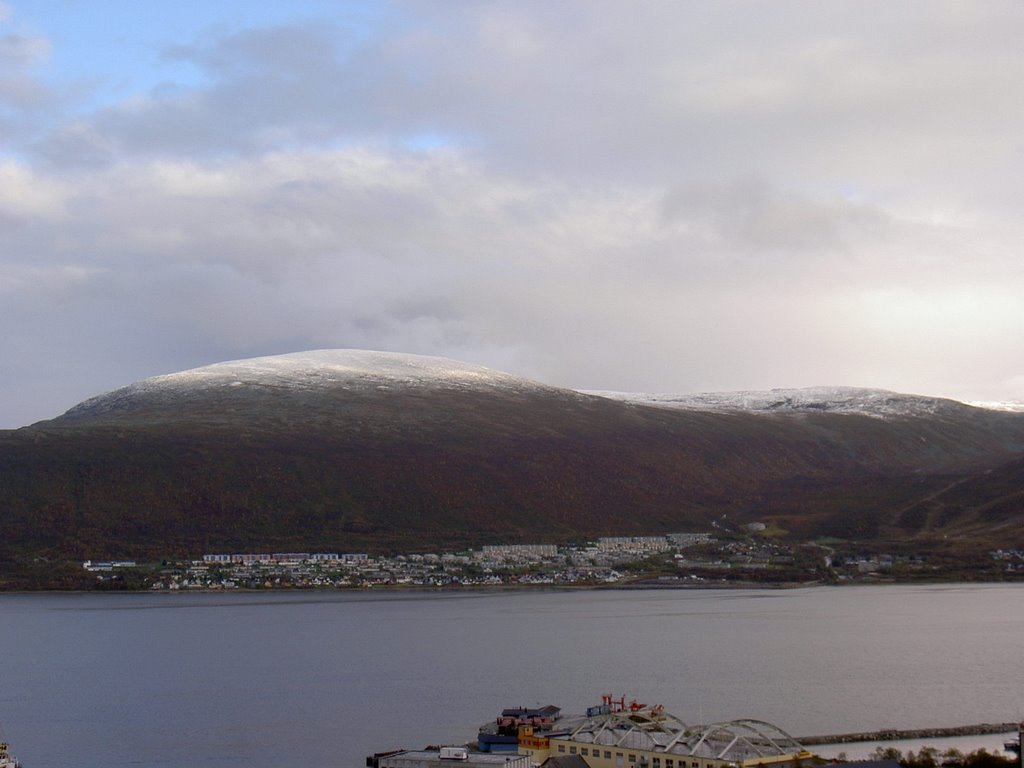
Today was the autumn equinox and, fittingly for the Arctic, we got our first snow here in Tromsø. Mind you, not in the city itself, but all the mountains around us dawned white this morning, from some 200 meters up. Then it melted a little throughout the day, but this was the view from my window at about 3:00 pm:

Saturday, September 16, 2006

Couldn't sleep

Just that, couldn't sleep.

So i watched "Spellbound" (1945) with Ingrid Bergman and Gregory Peck: period's the word here. Bergman's a psychoanalyst that's constantly being harassed by her co-workers but actually doesn't get angry about it; in fact, she seems to think it comes with being a woman. She gets patronized by everyone, too. Her best friend tells her stuff like "Do not complete that sentence with the usual female contradictions. You grant i know more than you, but on the other hand, you know more than me! Women's talk. Bah!" or "We both know that the mind of a woman in love is operating on the lowest level of the intellect." When a man she's not interested in flirts with her, kisses her on the mouth, tells her science is killing her womanliness, she reacts as if nothing bad happened! She doesn't retort to any of it, and goes along with his game...

And she's got other little quirks, too. I mean, not only does she get romantically involved with a patient, but she puts her career and life at risk for him after knowing the guy for about 8 hours, immediately after she figures out he's given her a false identity and is probably a psychotic murderer. "You're not", she tells him. "It's a guilt complex that makes you believe you did it." Hah!

Ok. Very dated, quaint... But cute. Still, can't sleep. Gonna try again...

Thursday, September 14, 2006

Lånekasse deals

It turns out that if you've worked a minimum of two years in Norway and you then decide to go back to school, you have the right to ask the state for a loan of up to 5000 kroner per month, and a stipend of 3000 kr per month. This is as much as the brochures said; also, according to them, the stipend doesn't need to be payed back ever, as long as you complete whatever course or career you're studying.

Super smart little me reasoned like this: "I'd like to avoid running a debt; since i have saved some $ these past few years, i'll only ask for the stipend, and pay the rest of expenses from my own pocket."

Pretty logical, right? Well, i've just found out that i've been awarded the money i asked for... But as a loan. Apparently, you don't get the stipend money until after you've asked for all the loan money.

Is that dumb or what? I mean, i could very well have asked for the full 8000, put the loan bit aside, untouched, to pay back as soon as i'm done studying, and then use those 3000. Instead, not only don't i get the 3000 i was counting on not to have to eat up all my savings, but now i have the worry of having to pay back afterwards...

Basically, by being set up like this the system seems to ask that you squeeze it to the maximum, or that people be dishonest. All right, so i have the means to pay for my own studies, because i have some savings. Should i be left penniless because of that? On the other hand, i see students here (most of them younger than me, granted) and they get the full deal... Plus their parents help them out quite a bit.

I'm looking for a part time job to do on weekends (gonna have to put a little more effort in that!) but of course, since my norwegian is not still quite as good as i'd like it to, it's gonna be tougher...

Oh well, i'll figure something out. I suppose from a certain point of view it does make sense not to pay a stipend to someone until they've taken a loan. Norwegian students do end up paying back their loans for years after they're done studying.

I won't take the deal, and get that job instead. Shikata ga nai!

Wednesday, September 13, 2006

What lies beneath

Yesterday night we had the last dive of the course. Tomorrow we take the written exams and, with luck, i'll be a certified open water diver afterwards. Oceans of the world, watch out!

Har-har. Actually, i'm still consuming about triple the amount of air the instructors do, which means i'm breathing and moving too fast, or fussying overmuch with the air controls in vest and dry suit. Both, probably. Also, my control of buoyancy is rather suckful, and that's the reason why you might still find me about one meter below or above where i want to be at any given moment.

Anyway, performance angst aside, the point is we were not supposed to dive at night. What happened was that the boss did not want to have to work through the weekend again, and so he packed all the dives into monday and tuesday afternoon; yesterday it got a bit late, and voilá! We had a dive in the dark.

It was incredible. We went down all together (4 of us) and spent 20 minutes below, each with a flashlight... Ironically, you see much more of marine life at night than in daylight. Everything seems to have awakened: clams taking off from the silt at the bottom and shooting across your field of vision, opening and closing their shells rythmically (jet propulsion, obviously, but so awkward-looking!); crabs with snail shells mounted on their backs, picking out invisible food out of the water, their mouths churning constantly; fish attracted to the light, coming closer and closer and then suddenly darting off; jellyfish pulsing all around you, different sizes and kinds, some with tendrils meters long, catching the light like spiderweb strands do in sunny summer days... After a while one of the instructors came around and signaled us to settle down on the seafloor and to turn all our lights off. When we did, we couldn't see him nor each other any longer, but this tiny blue sparks started appearing in the place he'd been. They were exactly the color of stars, and about their size, except they blinked in and out of existence. At first you distrusted their existence, but after a while their reality became more obvious, the pinpricks of light defining the arches of the instructor's hands waving in the water, the turbulence around them. He himself was not visible, but the sparks drew what he was doing. We caught on, and started to shake our hands too, and soon there was a cloud of plancton phosphorescing all around us.

Because you can't talk to anyone, you can't see anyone, and you can only hear the air rushing in and bubbling out of you... Well, i don't know what happens because of that. It felt very different.

How does one transmit these things, and what for? I can think of people who might read this and wish you'd been there with me, and there's a bit of regret you weren't, and this is my vicarious way of sharing this with you... Or perhaps i'm simply trying to make you envious.

I think writing about such experiences has to do, in part, with the freedom that writing allows you over speech. I may tell of this experience over the phone or face to face to my dearest friend, but to say some of what i write would feel awkward. Writing lets you go more into detail, right? Say the things that went through your mind at that moment, but that would be too awkward or out of place to repeat in regular conversation...

Or perhaps all this additional stuff is just an indicator that i write in a very stilted way. Should one write precisely in the way that one says things? There has to be a balance, i think, but how does one find it? After all, the amount of what one speaks is part of the way one does it, and sometimes there are days in which people won't speak the number of words they need to write a single paragraph. Does that mind they shouldn't write?

Blarb blarb. Got to go to norwegian class.

Saturday, September 09, 2006

Love at first hearing

If, either from the title of the entry or from my track record (?), you thought i was gonna be writing about someone i met on the computer or over the phone... well, you'll be disappointed. Basically, i just feel on the clouds with my classes. They make me giddy sometimes! I may have finally found my vocation, or maybe it's still the buzz of being a student again after 7 years. And no, i'm not smoking anything.

Anyway, i'm taking three courses this term, one cooler than the next. The first one is First Language Acquisition, in which we study how the ability to communicate develops in people. To say something about it, consider how hard it is to learn a second language well; yet by the age of five children have already learnt almost everything there's to know about their native language/s (they will keep adding vocabulary throughout life, but that's pretty much it). Think of the contrast in beginning conditions, too! By the time you attempt to learn a second language you already know, at least, that the strings of sound you hear are made up of individual words, that there are certain ways in which these can be put together, and that words are associated with concrete meaning. But how do you figure this out when you're a baby? I mean, even if you notice that the sound "cat" is associated with that furry thing that wanders around the house, how do you know "cat" doesn't mean "furriness", or "wandering" or "stripes in a tabby pattern"?

Did you know that at 4 days of age children can already distinguish the main language spoken around them from others? That at two months, after hearing a few sentences in a language, they can distinguish that language from most others, but that later in life they seem to lose this ability? (by the way, can you think of any way in which you could test this info? After all, children that young cannot speak, right? So how can one figure out what they can and cannot do? Impossible? Well, think again...).

The other two classes i'm taking are phonology and syntax. Basically the two look at how languages are put together, but since languages have many different layers of structure, phonology focuses on the level of words, and syntax on the level of phrases or sentences (other levels are phonetics, which deals with individual sounds and their production, organization and reception; semantics, which looks at how meaning is created and transmitted... Plus, there are areas of linguistics that look at the interfaces between the different levels: phonetics-phonology-syntax-semantics). Basically, these disciplines both attempt to tease out the simplest and most explicit set of rules that can describe the structure of language, its reason for being, and its evolution. In fact, the intention is to find a set of rules that will do this for all languages together. Sounds crazy? Well, it certainly is a grandiose view. But then again, physics wants to describe the whole universe, and nobody's complaining...

All of this work is based on the assumption that the language ability is innate, codified in the human brain to quite a large extent. Therefore, all languages will share "mechanic" characteristics that cannot lay outside of certain parameters. The search for those parameters is another way of looking at the linguistics enterprise.

The linguistic revolution began in the 1950s with Noam Chomsky, who postulated much of the above. If you haven't heard of any linguistics revolution, well, right now you're staring at a product of it... I mean your computer, dummy! IT owes a lot to linguistics (i mean Information Technology in general, not your computer in particular). What happens is, if you understand the methodological rules behind such a big part of brain-output as language, then you are actually getting a very revealing look at the internal workings of the brain. Now, if you can somehow duplicate this mechanisms on a machine... Voilá! You have a computer program.

Those annoying squiggly green lines that appear underneath ungrammatical phrases when you're writing your ToK essays are the least of it, too! Speech recognition, programming languages...

Of course, there is also a lot of debate. Is language really innate? If so, to what extent?

Anyway, i'm pooped. Going to bed...

Thursday, September 07, 2006

On arrows and crosses

Today us students presented the reading material in the First Language Acquisition class, instead of the teacher. She thought it would be good practice, i suppose, and a nice way of gauging our understanding without too much pressure (!). Anyway, it was fun, particularly because we didn't get to the article i was supposed to talk about. Har-har.

Some of the experiments dealt with how infants of each gender reacted upon being exposed to different sets of auditory stimuli. This bit was presented by my classmate Ksenia. She did a good job of it, but i want to write about a detail of her presentation that has nothing to do with linguistics.

You see, when she was drawing a graph to summarize the experiment, she represented the sexes with the traditional circle-and-cross symbol for girls, and circle-and-arrow symbol for boys... Except that, whereas i'd always seen the arrow placed on top of the circle, pointing up and kinda cocked (oops!) to the left, she placed it precisely underneath, centered and pointing down. I´d never stopped to really think about these little drawings, and so my mind just wandered away from the class, now. Luckily i'd already read the article...

OK, so i started pondering, kinda disconnectedly:

The "+" under the circle represents the vagina, and the arrow on top of it is the penis, right? Direct indeed, but one possible representation of sexual organs. Plus, don't tell me you hadn't thought of this, 'cause your mama may believe you, but i won't.

But why a "+"? Am definitely not an expert in this, but i think a vagina does not look like that. "|" might be a more accurate representation, or even "|" with a dot on top. As for the penis, the arrow is, albeit marginally, a more ideographically accurate depiction of it, whatever direction it may be pointing. Gotta get back to this issue of direction, though...

Next question: if the arrow and the cross represent the sexual organs, what do the circles stand for? Maybe the body, the torso... In that case, the cross is placed more or less accurately for women, but the arrow on top of the circle suggests that penises cap the necks of men, and that their heads are always cocked (oops again) to the left. Such an image tends to reinforce folk knowledge of the type "Men think with their dicks". Could the symbol be reflecting this kind of idea? If that's the case, the word "dickhead" would stop being an insult and become a simple statement when applied to any carrier of the y-chromosome.

However, if what the circle represents is the crotch, the arrow can indeed be placed on top of the circle. Nevertheless, the fact that this is so consistently the case may signal both an intention to mislead or great insecurity -- in the creators of the symbol, at least. That Ksenia drew the arrow pointing down is equally accurate, as anyone who knows a penis can assert. A possible compromise might be to draw a symbol with arrows pointing simultaneously up and down, but this might also confuse, as anyone who knows elementary biology can also assert.

As for femaleness, if we assign the value of "crotch" to the circle, the "+" or the "|" should be within it, since the vagina does not project from the crotch in any way, but is, indeed, within it. This new symbol would probably be much more liable to criticism (imagine :"A cross within a circle??? What do women think they are, the centre of the world???") but personally, i think it should be adopted anyway. Increased anti-establishment criticism directed towards women would mean there has been an equalization of genders within mainstream society.

So, next, one should look at the symbols of the cross and the arrow by themselves, away from their relationship to the circle.

That "x" marks the (G) spot is no mystery. What might you find underneath it? A treasure, perhaps? The place in the map where you want to get to, definitely. All kinds of symbolic thinking sprout from those too little intersecting lines.

As for the arrow... Well, we all know that men are warlike and violent, so giving them a penis that can also function as a weapon can only make them happy, right? Plus, you know, an arrow pierces, shoots... Crude, but fitting, particularly since in certain cultural environments such weapon-related terms are often used to refer to the penis or its functions (am back in linguistics arena! yay!).

Let's turn to history a little now. We know that these two symbols were used in antiquity (and still are, in astronomy) to mean Venus and Mars, and that the planets themselves were associated with greco-roman gods. That Venus, a goddess whose main attribute was the dispensation of love and beauty, is even today so closely associated with womanhood, really gives one pause. The same goes for Mars -god of war- and men.

I read somewhere that we people do all of our thinking in terms of symbols. We tie them and connect them in all sorts of ways and at different levels, and most of the time we don't even stop to look what we've done, so who knows the kind of tangles we end up with! Perhaps this is why noticing a little change in one symbol can induce us to retrace all its connection, and for once we really start thinking about what we really think...

This sounds like something that could be used in teaching, too: familiarize people with sets of situations or reasoning patterns, and then change little things, one at a time. Good way to induce questioning, to give people time to understand complexity, to build it themselves step by step, and own it... But wait, am not a teacher anymore. At least for now. So, stop! Although one may wonder what kind of student i am, if the mind wanders so in the middle of a class...

The regular type of student, i suppose.

Well, there must be bunches of books about all this sexual symbolism stuff, some of it probably quite interesting... I don´t think i'll look anything up, though. Got too many other readings assigned, so this bit of mental farting will have to suffice for now.

Wednesday, September 06, 2006

Dykking

Yesterday i started attending a two week diving course. It's a bit expensive (particularly now that i'm a student!) but since the teaching and the textbooks are in norwegian, i figure i'll be doing some language practice, too; more value for my kroner, i tell my conscience. It seems convinced. For the moment.

The first lesson consisted of two hours of lecturing, a couple of quizzes, and some practice on how to put together the vest, tank and hosing. I understood the theory and did the hands-on stuff quite ok, but the vocabulary in some of the quiz questions gave me trouble. I asked the teacher and the guy next to me about the meaning of a few words, but next time i'll just bring the dictionary along, so as not to seem so totally out of it.

As for the social aspect, well, no dictionary can help there! You know how it is: a small group of new people, everybody excited about the course, friendly, bantering, getting to know each other... My social skills are not very good even in the best of circumstances; in those hours, with norwegian stereo-surround, my brain squeezed to the utmost just to be able to extract the most general sense out of what people were saying, i simply became almost mute. I was so concentrated i even forgot to smile and nod, sometimes. My classmates and the teacher must have either found me totally morose, or been about to call a proctologist to get the stick out of my arse. Either way, it can only get better now.

The robot

Just woke up from the weirdest dream. Weird not only content-wise, but also full of little details which i don't usually remember from my dreams, if they're there at all...

Anyway, i was a student at UiTø, as i am in the waking world, except that instead of linguistics i was studying robotics. I know the dream was happening here because, although we were in a classroom i've never seen, the other students were people i've met around. At the same time, i remember thinking "i thought they didn't offer robotics at this place!" and feeling fortunate that in fact, they did. By the way, in reality they do not, but i'm ok.

The professor was this cute norwegian classmate from the phonology course, except he wore a black hat and had long, curly sideburns, like a hasidim. He said "today we're gonna have a practical lesson, so pick up your stuff and follow me." We did, and he took us to the secretary's counter, who introduced us to her robot and her husband, both one and the same: a chunky, squat, old fashioned telephone covered in pink, fluffy fabric. In the dream this seemed absolutely natural, as weird stuff usually does in dreams. Or it does in my dreams, at least. Of course, i know that robots are defined by their having moving parts, and that so far they don't marry people, however much Asimov may have written about that; as for the moving ability that could have made a robot of the telephone, well, in the dream he kept still, but perhaps he was simply a very quiet robot (and yes, you've noticed rightly: everybody referred to the robot as "he", though there was no physical evidence of gender anyone could discern).

The secretary went on to explain to us that he was very friendly and not only accompanied her to work, but stayed there to help her. She said other stuff to introduce him, but i don't remember what it was. I was whispering a translation of all this to some of the spanish Erasmus students, whose english is not soo good in actuality, either. The phone itself was, as i've said, very quiet. Either shy or stuck-up, i thought.

We were all clustered around the secretary's counter, in a bend of the corridor. When she was done talking the professor handed out photocopies with three questions that we were to discuss in our own little groups. I was with the spaniards again, plus a short french girl called Violette and others whose names i don't know yet. We all sat down in a circle on the corridor floor, and started working. I remember thinking that we were too close to the counter and felt a bit embarrassed that the secretary or the phone might hear us talking about their lives. One of the spanish girls apparently felt the same and whispered to me "shouldn't the professor have organized this better?".

The questions themselves have faded a little... I remember there being 4 pages in total, with technical-looking graphs tucked in the corners. One of the questions listed all the things that the robot did for the secretary (like, he was connected to all domestic implements in their house and could fix them and work them) and then went on to ask what else could the robot do for his wife. None of us sniggered or raised eyebrows at this question. Apparently, in the dream not only was it a given that he could do that for her, but it was such a non-issue that nobody even thought of bringing it up.

Raindrops splattering on my windowsill woke me up while we were still at work. This was 25 minutes ago and now i gotta get ready for phonology class. Wonder if the cute norwegian will show up today.

Sunday, September 03, 2006

Poufs

Recently i read the novel "Death Trick", by Richard Stevenson. Here's a short passage:

Bowman lost no time in showing me his winning personality. "Yeah, I've heard of you," he said after I'd introduced myself. "You're the pouf."

"What ever happened to 'pervert'?" I said. "I always liked that one better. It had a nice lubricious ring to it. 'Faggot,' too, I was comfortable with. The word had a defiant edge that I liked. 'Fairy' wasn't bad--it made us seem weak, which was misleading, but also a bit magical, which was wrong, too, but still okay. 'Pouf,' on the other hand, I never went for. It made us sound as if we were about to disappear. Which we aren't."

Saturday, September 02, 2006

Real estate

If you're 32 years old you should be married, have a well established job, and be thinking of your retirement. Ideally, you should also start looking for some real estate (careful nobody slips you some of the false kind); i mean, how and where will you live when you're old?

As a kid you watched cartoons that drilled into you the fable of the cicada and the ant in three or four different versions. In high school you read La Fontaine, and discussed his morals in Sunday school. You know workers contribute monthly, during fourty years, to private pension plans -- or instituted by the government, as they may be; you also know that when they retire it's not uncommon for them to have trouble making ends meet. People shake their heads and comment on the bad economy, saying that the old are too many to have to be supported by the present working force (those 40 years of contributions... well, that's like, before you were born, so technically they never existed).

So, it is wise to think ahead. Build around yourself as stable a situation as possible. Have a place to tether yourself to, so that no matter how the years flow, nothing can uproot you. Nothing can tempt you away. Pay back your loan for three decades and repaint the facade every three summers, so that if and when you reach old age... Well, you'll still have all that stability around you. Hopefully the loan will be fully paid, and someone can paint the facade for you when you can no longer climb the ladder yourself.

- - - - - -

I don't mind climbing ladders for my neighbours, and i think that, like me, there are many people who don't, either. And since there are always times in life when we need others to climb ladders for us, what is all the fuss about? We all get there, and either you're lucky to have someone who'll do it for you, or you won't.

Why are we so scared of getting old? And why are we so obsessed with paying?

We think of ancient Egypt and yes, we're awed by their achievements. But don't we also think they were deluded, to have organized their lives around the point beyond which it no longer existed? I mean, come on!!! Spend 40 years and the resources of a nation to build a pyramid around your yet non-existent corpse? Please!

Mind you, i'm not saying that old age is a dead time. I'm sure --i've seen-- it can be full of experiences, satisfying affections, learning, interests, passions, cares... And when i'm 82, i'll feel and do whatever it is i need to then. Now, however, i am not.

- - - - - - - - -

Anyways, all of this came up because i read on the paper that there's a big slump in the real estate market in the US. I don't dare hope this means young people today are finally seeing the trap in front of them and refraining from falling into it. But it'd be great, wouldn't it?

Imagine: you can live anywhere you want. Everywhere there are good schools for your kids, good doctors, easy access to information. You work in what you want, and your earnings are not invested in catering to your fears (for if you're covering your ass 40 years in advance, that's who you're catering to), but in developing yourself, your community, your species, your planet. The idea is to maximize the availability of enjoyment and learning opportunities for everyone.

Imagine the challenge of building places for people to live just for the sheer fun of it. After all, people are there, resources are there, a nature to be respected is there. Interesting equation to balance out! And since all your needs are covered, and fun can be had any time you want... Well, you'll either find something demanding to occupy your attention, or die of boredom!

- - - - - - -

This is the world i want to live in. I think it's possible.

It's also possible that if people content themselves with renting instead of buying real estate, this ends up falling in bulk into the hands of investors. At the beginning they rent it out at moderate prices, but as they become richer and richer, they begin to compete: they try to make more money to buy property off each other. They cut corners and prices go up. Since they have so much money, they control governments. Living standards fall. The Second Middle Ages are upon us.

- - - - - - -

Seriously, though. Let's be realists. You live in society as it is today. It may still function by pretty similar rules in a few decades, when you're no longer able to work for money (as an argentinean, however, i can tell you: don't count on it). What will you do then?

Granted, one must think of the future to some extent. If you're living in the polar circle, not to have any jackets for the winter would be quite stupid, regardless of how sunny it's been lately, right? So, you'll save some money, get on board a nice private pension plan with ethically sound investments.

But why BUY a place to live? I don't want to worry about leaking roofs, rotting pipes, taxes, loan interests nor paint jobs. If i want to move, i don't want to get stuck due to it being the wrong time to sell.

I'd rather pay rent for living space and not hock my freedom.

Sunday, August 13, 2006

More Tromsø

...And here's some more:


Northern part of Tromsøya (where i live!) as seen from the mainland.


Orange lichen + the southern part of Tromsøya.


Looks a bit like Bergen, don't it?

Saturday, August 12, 2006

Tromsø

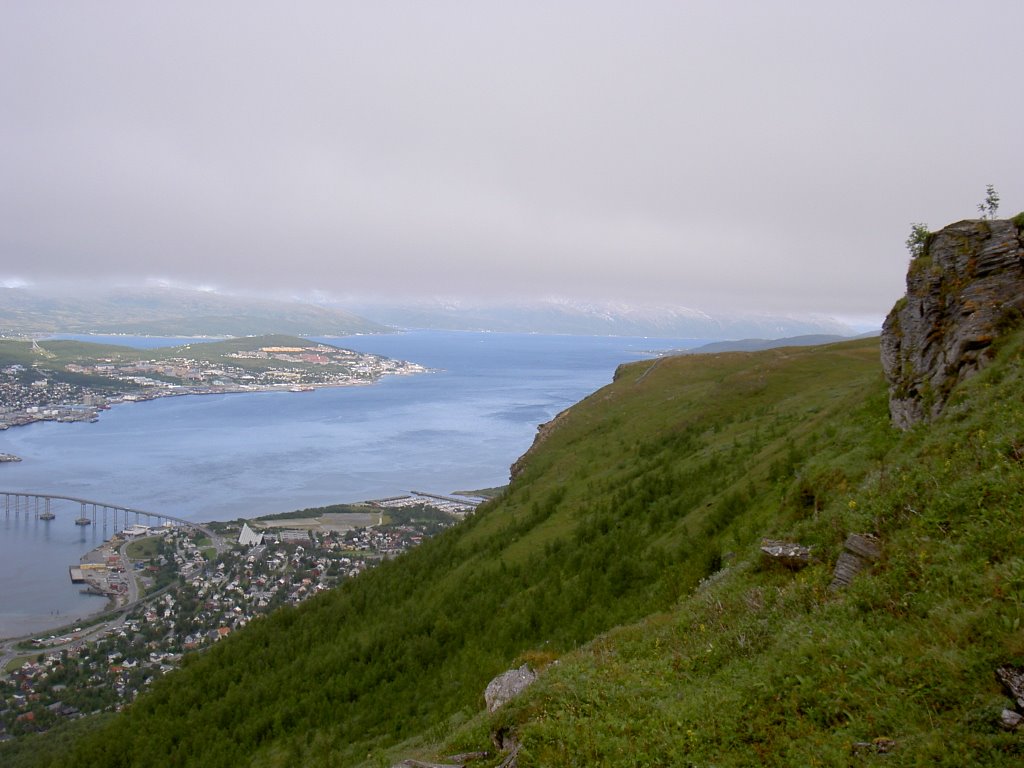
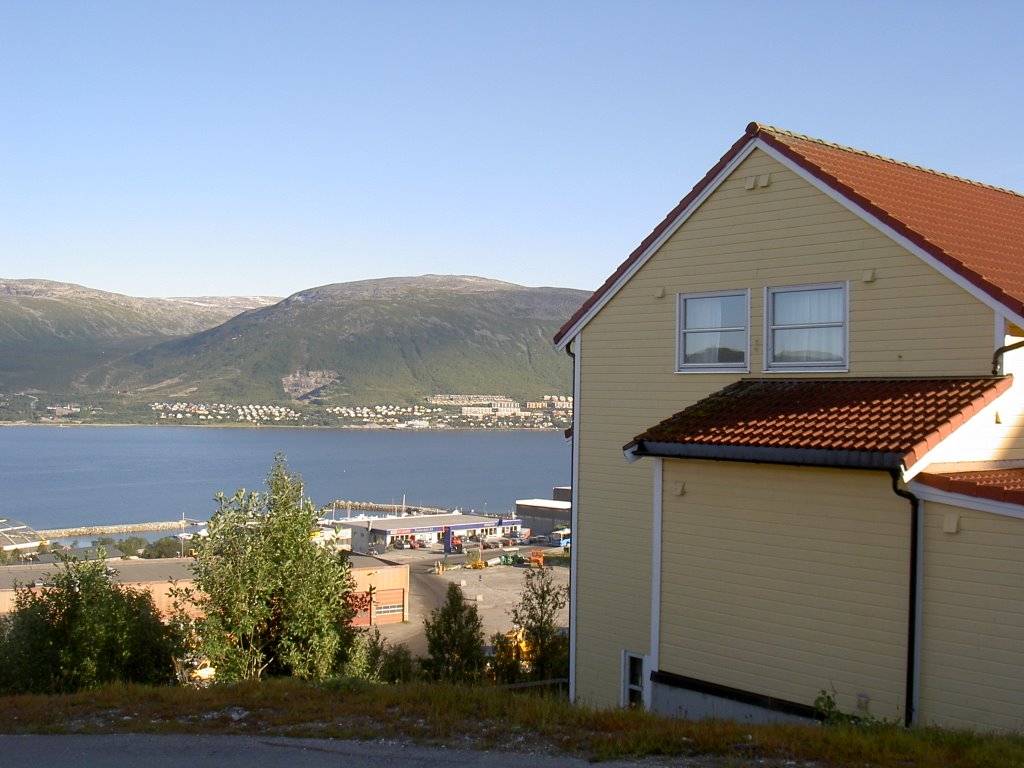
Here's some pics from this incredible place. It feels like home already!


This is building number 13 in Ørndalen student residence. My new room is in here, with a big window facing Tromsøysundet, the channel you see on the left.


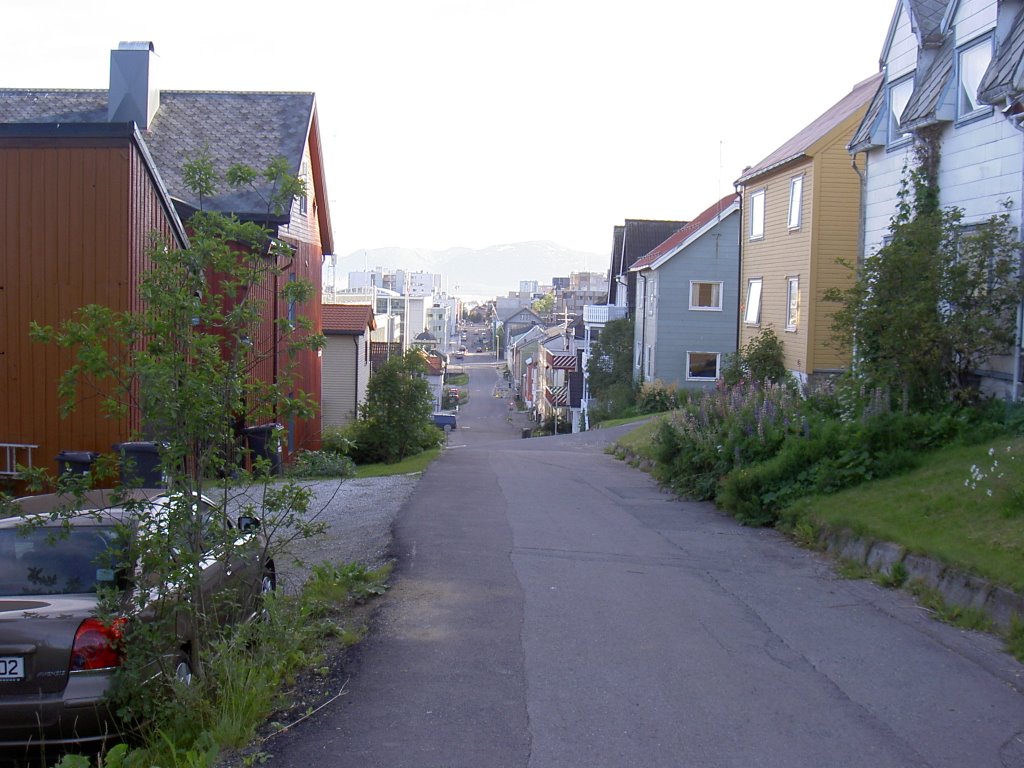
One non-descript street in the city. Pre-tty! Ain't it?


Twilight. August 5, 12:43 a.m.


More twilight, at around the same time. The plants you see silhouetted in the foreground are called "Tromsø palmer": ubiquitous throughout the island, it seems somebody introduced them about a hundred years ago, and now they're a weed. Nobody kills weeds here, though, and they're allowed to sprout from every crack and corner. The effect is one of exhuberance, particularly when, surrounded by explosive greens, one remembers this is actually the Arctic! Some Tromsø palmer get to be taller than people, with flower clusters bigger than a person's head. Amazing!


Downtown as seen from the mainland. Kvalsøya in the background.

Thursday, August 03, 2006

Fauna de una ausencia

Sin mi Manuel cada cabal segundo
tiene de elíptica jirafa el cuello
y me deja tendido, sin resuello,
como huyendo de lobo tremebundo.

Un atroz hipopótamo rotundo
e inescapable, contra el cual me estrello
es cada cruel minuto sin el sello
de esos ojos hondos en que yo me hundo.

En fin, se truecan en leoninos eones
las horas vacuas sin mi Manuel;
las alimento con trepidaciones

pan de ingenio y más planes con él
mas me desgarran sin contemplaciones
garras agudas la carne y la piel.

Dubrovnik, 23/07/2006, 3:32 am

He visto dos amigos que, perdidos,
sin saber han venido a terminar
de un callejón dormido, en un solar,
bajo hileras de lienzos extendidos

a secar. De mi ventana, encendidos,
les oigo, sigiloso, murmurar.
Aún bajo la escasa luz lunar
es obvio que son viejos conocidos.

Conversan. Uno propone partir,
tomar la ruta por la que han llegado.
Algo absorbe al otro, ahora callado.

Total silencio, lento revivir;
mano que se ha posado hasta cubrir
la mano ajena. Beso aposentado.

Cristal, cristal

Romper conmigo, decís, fue lo opuesto
de romper un cristal, un tiesto o un vaso
que por dejarme en un solo pedazo
quisiste vos quebrárteme. Si honesto

no fue mostrarte vulgar y molesto
atosigarme, medirme hasta el paso
para poder provocarme rechazo,
decís que declarar que ya ni resto

de aquel amor sentías sería peor.
Fue difícil, argüís, pero al fin
lograste aquello que te proponías,

que con agallas que vos no tenías
yo exigiera el ya no más. Lo más ruin:
forzarme a mí, si tuyo era el temor.

Piel confusa

Quise mi sed impedir. Te lié
y me di veintemil tesis. Me dije
si es vil sentirte en mí y que en ti me fije,
hiel ingerí, que hiel digeriré.

Mis perdices, infelices, libré.
Lijé mi ser, si, de ti, que quien rige
mi ingle ni es mi piel ni en mí te elige.
Cien grises directrices ingenié.

Duró mucho tanta fatal locura,
hasta borrar todo color humano
mas nunca nos brotaron alas albas.

Años apuñalados, horas calvas:
acoso tu tumba, otro gusano.
Busco solaz, mas solo hallo amargura.

Para Emma

El soneto me manda que explique Emma;
yo no sé cómo cuernos contentarla
porque ella sólo itañol parla
y entiende "polvo", pero no "poema".

Le explico que un soneto es un sistema
"14 versos", digo, pa' calmarla,
mas cuando de la rima le doy charla
se me arrima ella y cambia el tema.

Por eso, de cuartetos y tercetos
he decidido ya mejor no hablar:
debe un soneto ser convencional.

Concluyo, luego así, sin vericuetos,
a Emma forma y extensión mostrar.
Tal vez entienda, aunque es bien animal.

Soneto de Diego

No digo Diego donde dije digo
porque si Diego digo me deshago,
que de quien Diego dice es malo el pago
y al día en que lo dije lo maldigo.

Diego por mí no dio ni medio higo
pero por Diego yo me he dado al trago
desde que tengo el sentir, nada vago,
que por quien Diego da higos es Rodrigo.

Y aunque Rodrigo va ya mal rodado
(Diego da higos, mas son breves sus brevas)
mi gran desasosiego es con Diego:

amarle, luego, tanto no le he amado
y son más guapas hasta las amebas
mas donde me dio Diego es en el ego.

Thursday, July 13, 2006

Believes

I can't say I believe in a god... But i can't say i disbelieve him/her/it, either. That is to say, i don't know whether there is a god or not. In fact, i don't think that dilemma is at all relevant to anything. And i do have faith. I have simply placed it elsewhere, not in a god.

If i were God i wouldn't want people to believe in me. At least, that's what it seems to me from observing the world around me. After all, if God wanted belief, he would make his existence indubitable, right?

Yes, i know that many believers would disagree with me here, that God requires "a leap of faith", or that s/he/it doesn't want to take away our freedom by imposing his existence on us, or that there are people out there that, no matter what God did, would still not believe -- the last of which would mean, incidentally, a not omnipotent God. But that's not my point. Just bear with me a little longer.

If there is a god that created everything we perceive, what we can be certain about is... everything we perceive! Trees and animals don't come stamped with a "Made by God" seal, yet trees and animals like us are here. And so are rocks, water, vacuum, fire...

I think if God exists at all in this universe he wants us to believe in his creation... That is, in each other. That is why he/it/she doesn't boom out of the sky or has neon signs that point to him/er/it. You see, believing in certain types of god allows us to discard some of those who surround us, if they're deemed to be ungodly. If it is seen as unholly, we can violate nature, too (although, if truth be told, apparently we don't need to think it unholly to violate it; that it is not God seems to be enough for us...).

But if you put your faith in life, in the idea that people can be good to one another and protect and manage their environment, in the intrinsic value of everything that exists, then you HAVE to think and BE AWARE of the world around you. And if i were God and had put a brain in people, that is precisely what i'd want people to do with it! Hence, i'd arrange things so that i became as inconspicuous as possible, so that people did not have me there to look up at all the time. Forget about what i'd want! What is best for YOU?

You see, whether God exists or not, i believe people as a species have the power to learn. We can eventually learn that we individually are safest when the largest possible number of us is safest. We can eventually learn that variety is fertile ground and that its lack kills. We can eventually learn that allowing individual ambition to soar above common rights is dangerous and must never be allowed in ourselves.

Friday, May 19, 2006

Never

'Never say never'
you say
and say it twice.
The double negative
makes it right
(you say).
Now with you i never know
what never is
when in your lips
or mine.
-No- -Yes-
i'm ever lost
but you
you're never wrong.

Tuesday, May 09, 2006

A REQUEST

I haven't written about homosexuality in a while, and you know how we queers are: it's all we think about. So, with a reputation to keep, here i go again.

Anyway, someone's asked me how i came out to my family, and what their reactions were. Hmmm... Well, here's an outline:

• 13 years old: M. knows he's sexually attracted to guys rather than girls.
• 18 years old: It finally occurs to M. that it may be ok to be sexually attracted to guys rather than girls.
• 22 years old: During a summer vacation at home, M. finally decides to tell his family about his being sexually attracted to guys rather than girls. He writes a letter to leave with them in case they kick him out of the house when he tells them.
• 22 years old: M. chickens out, doesn't tell them a thing, and the letter remains at the bottom of his suitcase. The chicken!!!
• 25 years old: Mom is visiting from Argentina and, during a very philosophical conversation, M. finally manages to tell her that he is attracted to guys rather than girls (and that the guy they had dinner with some days before is not just a friend, but actually his boyfriend.)
• 25 years old: Mom tears up a little and says "Finally!", and "I suspected he was your boyfriend." Then goes on to clarify she's known M. is sexually attracted to guys rather than girls for the past three years. Turns out she found the letter while going through M.'s suitcase ["Wanted to iron your shirts before you left!"]: showed it to dad, showed it to M.'s brothers, cried, cried, cried and cried some more. Then started thinking and, over some months, tried to fit her image of fags with that of her son. No fit, image of fags thrown away. Now M. finally figures out why so many conversations with mom have lately been so philosophical.

Now filling in the gaps:

Thing is, when you are growing up and you realize you're gay, sometimes you don't have anyone to talk to. You hear all these negative things about people who are supposedly like you (from what you see when they're portrayed in the media, they are not really like you, but hey, maybe you will eventually turn into them?); you hear these things from your parents, from your nearest friends, on TV, at the movies... The Bible says you should be stoned to death. You see how everybody laughs and despises and is angry at this people and, of course, you don't want to lose family and friends, so you just don't say anything. This means keeping a careful watch of all your words and interactions, so that your image of heterosexuality is unquestionable. Then eventually you realize nobody knows you, and you feel alone; that you have lied to every person you care about, and you feel like a shit; that all you do and say is carefully choreographed, and that you don't know who you are anymore. But, shikata ga nai.

If you are lucky enough to one day come across a message different from what you've received until then, you might start thinking (but again, you might not) that maybe the media are wrong. Your friends are perhaps wrong, too. That your parents are wrong is harder to consider, but you finally get your mind around that as well. What do you do?

You tell yourself many things, and all of them may be true: -- they will suffer if i make them go through this -- after all, i'm gay myself, and it took me years to accept it; how can i expect them to understand? -- wait, it wouldn't be me making them suffer, but their prejudices -- do i really need to tell them? -- why do i feel i need to tell them? -- after all, i live far away and only spend 3 or 4 weeks at home every one or two years -- besides, dad's old; what if this is too much for him? -- or they may kick me away, and what would i do without them? -- without their support -- and talking about support, yes: what about economical support? i couldn't stay in college if i didn't have it -- what kind of person am i, to be bringing money into this equation?

Bottom line: there's no definitive answer to any of these, so you just keep asking them.

- - - - - - - - - - - -

So yes, the moral of my story is totally wrong. I was scared in this way for a long time, and when i finally decided to talk openly with my mom, she had already done all the work on her own, when I should have been there to ease her fears and answer her questions. This must have been terribly hard on her.

- - - - - - - - - - - -

I have gay and lesbian friends who view coming out as a moral duty of any person of a different sexuality. They argue that society can only change if more people make themselves visible as homosexuals, because only openly can prejudices be challenged. And they are right, in this wider social sense.

On the other hand, there are people like my friend Dan, whose parents kicked out when he was 16. He is now 38, and they still don't want anything to do with him.

In my opinion, each person knows their families best and so can better judge their possible reactions (and still be wrong, as in my case). Thus, everybody should decide by him/herself what course is best. Nobody can ask us to sacrifice the private for the social, nor viceversa.

Both coming out to loved ones and not doing it are potentially very stressful situations, so the first thing one should have is support. If one can't talk about issues concerning sexuality with friends or known people, an anonymous care giver is a good idea. If none is available, there is the net. It wasn't a very good a resource a decade ago, but i imagine that nowadays, even if one lives in an absolutely homophobic society, a help line can be found. The words you read or the voice you hear might be on the other side of the world, but it's good to know they're there.

- - - - - - - - - - - - -

Finally, a few more thoughts and info:

• I think if i hadn't eventually come out to my family, i would have continued to grow more and more distant from them. Not that i would have ever stopped talking to or caring about them, but they would have known less and less of my emotional life. I don't know how much that would have affected us. Probably quite a bit.

• Good resources on the topic of coming out to loved ones are the following:

Coming Out to Parents: A Two-Way Survival Guide for Lesbians and Gay Men and Their Parents, by Mary Borhek

Growing Up Gay and Lesbian (VHS)

(Both available on amazon, and at certain school libraries)

Friday, March 31, 2006

Words for noises and sounds

On thursday i attended an art exhibition on the theme of silence. First off was a speaker who rattled on about the differences between sound and silence. Most of the time he seemed to be stating the obvious. Somehow i started thinking about words we use to describe sounds and, since i was bored, i started scribbling some of them down. Here they are:

bang___________estallido
bark___________ladrido
beep___________sonido electrónico
bellow_________bramido
bleat__________balido
bleep__________pitido
boom___________retumbo
bump___________ruido sordo
buzz___________zumbido
cackle_________cacareo
chatter________cotorreo
chime__________repique
chink__________tintineo
chirp__________pío
chirrup________pío
chortle________carcajada reprimida
clamour________clamor
clang__________estruendo metálico sonoro
clank__________estruendo metálico sordo
clap___________aplauso
clapping_______aplausos
click__________chasquido
clucking_______cacareo quedo
cooing_________arrullo
crack__________crujido
crackle________chisporroteo
crash__________choque
creak__________rechinamiento
crunch_________crujido
cry____________grito
crowing________cacareo de gallo
drone__________zumbido
drumming_______tamborileo
echo___________eco
explosion______explosión, estallido
gnashing_______rechinamiento de dientes
grinding_______rechinamiento
guffaw_________carcajada
gurgle_________gorgoteo
hoo-ha_________estrépito
hoot___________bocinazo
howl___________ululato
hum____________tarareo
jingling_______cascabeleo
knock__________golpe
laugh__________risa
lowing_________mugido
mew____________maullido
moo____________mugido
mumble_________murmullo
murmur_________murmullo
noise__________ruido
patter_________golpeteo
peal___________sonido musical como de campanas
peep___________pío
pip____________pitido
ping___________sonido metálico
plonk__________golpe seco
plop___________plaf
puff___________soplido
rasp___________chirrido
racket_________estrépito
rattle_________cascabeleo
raucousness____estridencia
reverberation__reverberación
ring___________timbrazo
ringing________reverberación
rip____________rasguido
roar___________rugido
rumble_________retumbo
rumour_________rumor
rustle_________frufrú
scraping_______rasguido
scream_________grito
screech________chillido
shriek_________grito agudo
snap___________chasquido
snicker________risilla
snigger________risilla
snivel_________lloriqueo
snore__________ronquido
sound__________sonido
speech_________habla
splash_________chapoteo
splutter_______chisporroteo
squawk_________graznido
squeak_________rechinamiento
squeal_________chillido
stridency______estridencia
swish__________frufrú
thunder________trueno
ticktock_______tictac
tinkling_______cascabeleo
trill__________trino
twang__________tañido
twitter________pío
wail___________vagido
warble_________gorjeo
weeping________llanto
whack__________golpe fuerte
whine__________gemido
whinny_________relincho
whirr__________runrún
whisper________susurro
whistle________silbido
whoop__________alarido
whoosh_________susurro
yell___________grito

English seems to be more varied than spanish... At any rate, words that describe sounds tend to be, in general, much shorter and more onomatopoeic in english than in spanish, and so the sounds they define seem to be much more precise and easier to recall (although maybe it is my command of spanish that is sinking).

Onomatopoeic words are everywhere in english. When you say "brush", you can hear its stiff bristles rasping against the thick hairs of a tangled mat of wool. When you say "clump", the four consonants plonking around that lonely "u" mirror the compactness of the clump itself, forming, coming together. And who can't hear the hooting in "owl"?

Of course, many spanish words also have clear onomatopoeic origins, but they have moved farther away from the original sound they describe. You can hear the "cry" in "grito", for instance, but that "to" at the end has been added by the necessities of gender and conjugation, so pervasive in romance languages. Still, when i say "rueda" (wheel), i fancy i can hear the rumble of heavy wooden carts rolling on uneven ground.

Anyway, what is the meaning of thinking about this? What can be its utility?

Wednesday, March 29, 2006

The Platypus

I read somewhere that the platypus knows its world through its bill. Because it spends most of its time in dark, murky waters, its eyes are not much use to it; to compensante, bioelectricity courses through the platypus' bill and creates an electromagnetic field. In that way, if anything comes within the range of the field, the animal senses the corresponding alteration in the field lines, and "sees".

What does the platypus perceive? Can it know colour and texture? Possibly not, and yet they seem so obvious to us... Perhaps there are other qualities to reality that we ourselves are not aware of because of our sensory apparatus. Maybe the platypus knows some of them... Or it may also be that neither platypi nor people sense anything that is real, and our senses only give us approximations of reality, enough to allow us to function in it.

I suppose the platypus does not feel the lack. Its senses have evolved to fit its needs, and the same applies to us. But what happens when needs change, or when we are (dumb? smart? cozy?) enough to ponder all this?

Tuesday, March 14, 2006

Octavia Butler dead

I've just found out that one of my favourite writers died on February 24th. It is a big shock. Of course, i didn't know the woman, only her writing and a little about her biography, yet it's disturbing to read she's dead... Mostly because i won't be able to read any new books from her, perhaps? Expecting them was great company, after all.

Sunday, March 05, 2006

Nemi

I understood a norwegian cartoon today. Yay! (The fact that i see this as a feat is no reflection on norwegian humour, but on my still shitty command of norwegian.) The cartoon basically goes like this:

Nemi is at a bar and the guy next to her yells at someone outside of the frame:

#@%&#@ homo! God made Adam and Eve, not Adam and Arne!

Nemi punches him in the face, leaves, and mutters:

God must be gay, too. Otherwise, he would not have made so many assholes!

Har har har!

Monday, February 27, 2006

As i was going up the stair

As i was going up the stair
i met a man who wasn't there.
He wasn't there again today.
I wish, I wish he'd go away!

By Wilson Hughes Mearns (1878-1965)

Monday, February 20, 2006

A tale of an uncaring mother

My brother's wife has a very interesting family history. Her paternal grandfather, for instance, fled Croatia at the time of WWII, running from the nazi pogrom. He was so scarred by that experience that his children didn't know about it until the man was about to die, some 40 years later. Even then, he kept telling them it was better that they not know much, that they "should never attempt to go back". He was scared for them, perhaps? Had he done something terrible in order to get away?

What i was remembering earlier today, however, is the story of one of her maternal great-grandfathers, son of a spanish criollo and a pehuenche or puelche woman. According to the story, the criollo man was a police inspector in some little town in Mendoza province, at a time when some mapuches were still living according to their own traditions in that region. I imagine it must have been at the end of the XIXth century, because those were the last years the indians kept some of their freedom. After that, it was mostly integrate, or die.

In any case, the inspector had to visit the mapuches' tent-villages from time to time, as part of his duties. A young woman caught his eye there, and although she was already in love with a man of her tribe, the inspector's authority had apparently had enough weight to make her leave her people and marry him in town. Over the next 5 or 10 years, she bore him 3 kids, one of them being Celeste's great-grandfather. Then, one day, she abandoned them all and went back to her man and her people.

This story stayed in Celeste's family because her great-grandfather always told it with great anger. In his view, the inspector had brought his mother to civilization, giving her a "real" house and taking her away from "the wild"... And she had paid him by abandoning him and his children. I imagine it must have been hard for a little boy to understand this abandonment, especially growing up with such a father... Even for the grown man he became it was obviously impossible. This is probably the reason why neither her name nor her people's are remembered in the family.

Saturday, February 18, 2006

Marilena la malabarista

Conozco una muchacha
requeteachicharrada
que con el fuego juega
y se mea en la cama.

Sus hombres: un patrón.
todos machos de acción
tocaos en la cabeza.
Pero ¡guau, qué erección!

Ojalá espabilara,
se dejara 'e pavadas.
Al fin para problemas
el circo diario basta.

Saturday, February 04, 2006

Another Poem

Funeral Blues

Stop all the clocks, cut off the telephone,
Prevent the dog from barking with a juicy bone,
Silence the pianos and with muffled drum
Bring out the coffin, let the mourners come.

Let aeroplanes circle moaning overhead
Scribbling on the sky the message He Is Dead.
Put crepe bows round the white necks of public doves,
Let the traffic policemen wear black cotton gloves.

He was my North, my South, my East and West.
My working week and my Sunday rest,
My noon, my midnight, my talk, my song;
I thought that love would last forever; I was wrong.

The stars are not wanted now: put out every one;
Pack up the moon and dismantle the sun;
Pour away the ocean and sweep up the wood;
For nothing now can ever come to any good.

-- W. H. Auden

A babe unborn i grieve

A babe unborn i grieve
a hollow in my arms
a child never conceived
a love that i can't give
but that i have.
Locations of visitors to this page